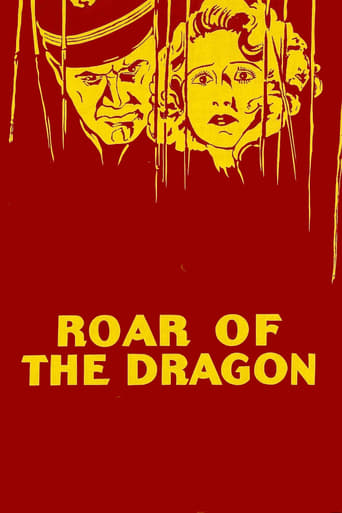
Roar of the Dragon (1932)
A boatload of Westerners is trapped in Manchuria as bandits led by Russian renegade Voronsky ravage the area. Seeking refuge in a fortified inn, the group is led by the boat's Captain Carson, who becomes involved with a woman who "belongs" to Voronsky. Carson must contend with the bandits outside and the conflicting personalities of those trapped inside the inn, as well as dealing with spies among the inn's personnel.
- Date of release
- 1932-07-08
- TMDB
- 6.5 / 10 (6)
- Runtime
- 1h 9m
- Genres
- Adventure, Romance
- Director
- Wesley Ruggles
Casting
- Richard Dix — Carson
- Gwili Andre — Natascha
- Edward Everett Horton — Busby
- Arline Judge — Hortense O'Dare
- Zasu Pitts — Gabby Woman
- Dudley Digges — Johnson
- C. Henry Gordon — Voronsky
- William Orlamond — Dr. Pransnitz
- Arthur Stone — Sholem
- Toshia Mori — Chinese Proprietor's Daughter
- Will Stanton — Sailor Sam
- James Wang — Hotel Proprietor
Interesting facts
Roar of the Dragon is a 1932 American Pre-Code adventure film directed by Wesley Ruggles and written by Howard Estabrook and released on July 8, 1932. The film stars Richard Dix, Gwili Andre, Edward Everett Horton, Arline Judge, and ZaSu Pitts. It follows tourists and a riverboat crew as they resist attacks from a vengeful bandit while the riverboat is in repair. The story is based on A Passage to Hong Kong by George Kibbe Turner. Some concern arose concerning Horton's pay, but it remained unaddressed. Upon its release, Roar of the Dragon received reviews both praising and criticizing its action elements.
Production and release
Roar of the Dragon was produced and distributed by RKO Pictures. Its storyline was developed and written by Merian C. Cooper and Jane Bigelow, who based it on A Passage to Hong Kong by George Kibbe Turner. Scripts for the film were written from winter 1932 to spring of the same year by Howard Estabrook. Production commenced in May.
The film location that portrayed Manchuria was credited as "Chinese street". At the time, Hollywood was pushing to increase its volume of "Oriental pictures", creating a goal to provide 30,000 workdays for Chinese American film extras. Roar of the Dragon was produced in pursuit of this goal. Typically Chinese Americans playing silent roles in Hollywood films earned $7.50 a day while those with speaking roles earned $10-$15 a day.
Roar of the Dragon was released on July 8, 1932.
Read on Wikipedia · Text from Wikipedia, CC BY-SA 4.0. Data from Wikidata.
Recommended
- Weekend in Taipei 2024 · ★ 6.5
- Tarzan and the Amazons 1945 · ★ 6.4
- Prince Charming 2001 · ★ 6.9
- Mackenna's Gold 1969 · ★ 6.6
- The Big Sky 1952 · ★ 6.6
- Solo: A Star Wars Story 2018 · ★ 6.5
- Earth to Echo 2014 · ★ 5.9
- Babylon 5: The Legend of the Rangers - To Live and Die in Starlight 2002 · ★ 6.0
- Mythica: A Quest for Heroes 2014 · ★ 5.9
- Jack Hunter and the Quest for Akhenaten's Tomb 2008 · ★ 6.2
- Jack Hunter and the Lost Treasure of Ugarit 2010 · ★ 6.5
- Alita: Battle Angel 2019 · ★ 7.3