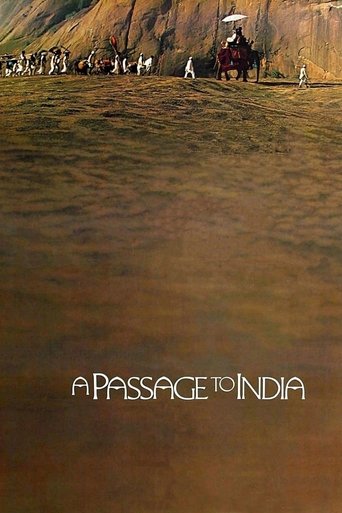
A Passage to India (1984)
David Lean, the Director of "Doctor Zhivago", "Lawrence of Arabia" and "The Bridge on the River Kwai", invites you on . .
Cultural mistrust and false accusations doom a friendship in British colonial India between an Indian doctor, an Englishwoman engaged to marry a city magistrate, and an English educator.
- Date of release
- 1984-12-14
- TMDB
- 6.8 / 10 (354)
- Runtime
- 2h 43m
- Genres
- Drama, Adventure, History
- Director
- David Lean
Casting
- Judy Davis — Adela Quested
- Victor Banerjee — Dr. Aziz H. Ahmed
- Peggy Ashcroft — Mrs. Moore
- James Fox — Richard Fielding
- Alec Guinness — Professor Godbole
- Nigel Havers — Ronny Heaslop
- Richard Wilson — Mr. Turton
- Antonia Pemberton — Mrs. Turton
- Michael Culver — Major McBryde
- Art Malik — Mahmoud Ali
- Saeed Jaffrey — Hamidullah
- Clive Swift — Major Callendar
Interesting facts
- Budget: £17M
- Based on: A Passage to India
- Awards: 4 · Nominations: 11. Including: Academy Award for Best Supporting Actress; Academy Award for Best Original Score; National Board of Review: Top Ten Films; National Board of Review Award for Best Film
A Passage to India is a 1984 epic period drama film written, directed and edited by David Lean. The screenplay is based on the 1924 novel of the same name by E. M. Forster and the 1960 play adaptation by Santha Rama Rau. The film stars Peggy Ashcroft, Judy Davis, James Fox, Alec Guinness, Nigel Havers, and Victor Banerjee.
Production
E. M. Forster began writing A Passage to India during a stay in India from late 1912 to early 1913 (he was drawn there by a young Indian Muslim, Syed Ross Masood, whom he had tutored in Latin), completing it only after he returned to India as secretary to a maharajah in 1921. The novel was published on 4 June 1924.
A Passage to India deals with the delicate balance between the English and the Indians during the British Raj. The question of what actually happened in the caves remains unanswered in the novel. A Passage to India sold well and was widely praised in literary circles. It is generally regarded as Forster's best novel, quickly becoming a classic of English literature.
Over many years several film directors were interested in adapting the novel to the big screen, but Forster, who was criticised when the novel was published, rejected every offer for the film rights, believing that any film of his novel would be a travesty. He feared that whoever made it would come down on the side of the English or the Indians, and he wanted balance.
David Lean had read the novel and saw the play in London in 1960, and, impressed, attempted to purchase the rights at that time, but Forster, who rejected Santha Rama Rau's suggestion to allow Indian film director Satyajit Ray to make a film, said no.
Following Forster's death in 1970, the governing board of fellows of King's College at Cambridge inherited the rights to his books. However, Donald Parry, his executor, turned down all approaches, including those of Joseph Losey, Ismail Merchant and James Ivory, and Waris Hussein, who after adapting Santha Rama Rau's play for the BBC in the 1960s now wanted to make a feature film.
Read on Wikipedia · Text from Wikipedia, CC BY-SA 4.0. Data from Wikidata.
Recommended
- The Last of the Mohicans 1920 · ★ 6.3
- The Lost City of Z 2017 · ★ 6.4
- Cave Rescue 2019 · ★ 6.0
- Viceroy's House 2017 · ★ 6.7
- The Way Back 2010 · ★ 7.0
- The Wind and the Lion 1975 · ★ 6.5
- Victoria & Abdul 2017 · ★ 6.9
- True Spirit 2023 · ★ 7.0
- Squanto: A Warrior's Tale 1994 · ★ 6.8
- Kings of the Sun 1963 · ★ 6.2
- Tenzing 2026 · ★ 8.1
- Ben-Hur 1959 · ★ 7.9