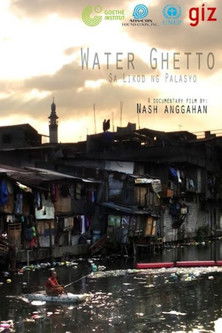
Water Ghetto (2011)
Water Ghetto (Sa Likod ng Palasyo) is a direct cinema film about Muslim informal settlers living on a canal at the back of the official residence of the President of the Republic of the Philippines. Fitumanan and Minombao, who both live with rigid principles and convictions are from far away province in Mindanao. They migrated to Manila together with their families with high hopes as they expect a more comfortable life in the capital city. They built shanties on a canal near Malacanang Palace which goes through Pasig river. They have been living here for decades, in fact this is where their children grew up. But for how long will they stay at the side of this canal? Where will their principles and convictions take them once their houses be demolished?
- Date of release
- 2011-01-01
- Genres
- Documentary
- Director
- Nash Ang
Interesting facts
Water Ghetto, originally developed as the short film iskWater, is a 2011 direct cinema documentary film directed by the Nash Ang. The film focuses on a community of Muslim informal settlers living over a canal behind Malacañang Palace, the official residence of the President of the Philippines. It was Ang's first feature-length documentary and premiered at the 3rd DMZ International Documentary Film Festival in South Korea in September 2011.
Background and production
The documentary originated as a feature-length expansion of Ang's 2010 short film iskWater (alternatively titled Water), which explored the migration of Muslim settlers from Mindanao to Manila and their informal settlement behind Malacañang Palace. This was his first short film, produced while he was studying broadcasting at the Polytechnic University of the Philippines.
In December 2010, iskWater won the champion prize at the Southeast Asian Student Documentary Awards (SEAdocs) at the Science Film Festival in Bangkok, Thailand, an event organized by the Goethe-Institut and UNESCO to raise environmental awareness. That same year, another version of the short titled Water also won the Grand Prix at the ASEAN-Korea Multimedia Competition in Seoul, South Korea.
Ang subsequently secured a development grant from the Goethe-Institut to expand the project into a feature-length documentary, focusing on the Muslim migrant community settled over the esteros behind Malacañang Palace. Using observational methods, Ang spent several months living in the settlement. The production used direct cinema techniques, relying on observational footage of the residents without voice-over narration or reenactments.
Read on Wikipedia · Text from Wikipedia, CC BY-SA 4.0. Data from Wikidata.
Recommended
- McQueen 2018 · ★ 7.4
- My Mom Jayne 2025 · ★ 8.0
- Avatar: The Deep Dive - A Special Edition of 20/20 2022 · ★ 7.2
- S4: The Bob Lazar Story 2026 · ★ 8.4
- In the Realms of the Unreal 2004 · ★ 7.2
- 28 Up 1985 · ★ 7.5
- Elstree 1976 2015 · ★ 6.2
- Marvel Studios Assembled: The Making of Hawkeye 2022 · ★ 7.2
- A Toxic Love Story 2026 · ★ 6.4
- 35 Up 1991 · ★ 7.6
- Sherman's March 1986 · ★ 6.3
- The Class of ‘92 2013 · ★ 7.1