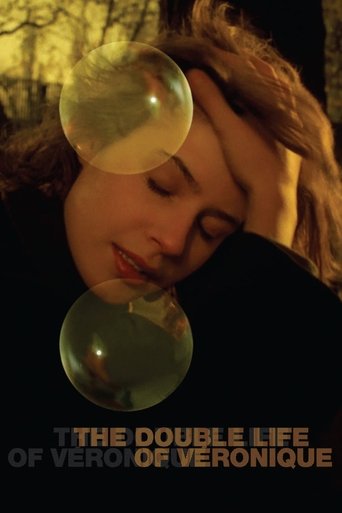
The Double Life of Véronique (1991)
La Double Vie de Véronique
Each of us is matched somewhere in the world, by our exact double - someone who shares our thoughts and dreams.
Véronique is a beautiful young French woman who aspires to be a renowned singer; Weronika lives in Poland, has a similar career goal and looks identical to Véronique, though the two are not related. The film follows both women as they contend with the ups and downs of their individual lives, with Véronique embarking on an unusual romance with Alexandre Fabbri, a puppeteer who may be able to help her with her existential issues.
- Date of release
- 1991-05-15
- TMDB
- 7.5 / 10 (937)
- Runtime
- 1h 38m
- Genres
- Drama, Fantasy
- Director
- Krzysztof Kieślowski
Casting
- Irène Jacob — Weronika / Véronique
- Halina Gryglaszewska — Auntie
- Philippe Volter — Alexandre Fabbri
- Guillaume de Tonquédec — Serge
- Kalina Jędrusik — Crazy Woman
- Aleksander Bardini — Conductor
- Władysław Kowalski — Weronika's Father
- Jerzy Gudejko — Antek
- Janusz Sterninski — Lawyer
- Sandrine Dumas — Catherine
- Louis Ducreux — Professor
- Claude Duneton — Véronique's Father
Interesting facts
- Box office: $2.2M
- Filmed in: Kraków and place de Jaude
- Awards: 2 · Nominations: 6. Including: Cannes Film Festival Award for Best Actress; National Society of Film Critics Award for Best Foreign Language Film
The Double Life of Veronique is a 1991 drama film directed by Krzysztof Kieślowski, and starring Irène Jacob and Philippe Volter. Written by Kieślowski and Krzysztof Piesiewicz, the film explores the themes of identity, love, and human intuition through the characters of Weronika, a Polish choir soprano, and her double, Véronique, a French music teacher. Despite not knowing each other, the two women share a mysterious and emotional bond that transcends language and geography.
Production
The film incorporates a strong metaphysical element, yet the supernatural aspect of the story remains unexplained. Similar to Three Colours: Blue, Preisner's musical score plays a significant role in the plot and is credited to the fictional Van den Budenmayer. The cinematography is highly stylized, utilizing color and camera filters to create an ethereal atmosphere.
The film was shot at locations including Clermont-Ferrand, Kraków and Paris.
In November 2006, a Criterion Collection region 1 DVD was released in the United States and Canada, which includes an alternative ending that Kieślowski changed in the edit at the request of Harvey Weinstein of Miramax for the American release. Kieślowski added four brief shots to the end of the film, which show Véronique's father emerging from the house and Véronique running across the yard to embrace him.
Zbigniew Preisner composed the score; however, in the film, the music is attributed to a fictitious 18th-century Dutch composer named Van den Budenmayer, who was created by Preisner and Kieślowski for use in screenplays.
Music credited to this imaginary composer also appears in Kieślowski's Dekalog (1988) and Three Colours: Blue (1993). In the latter, a theme from Van den Budenmayer's musique funebres is quoted in the Song for the Unification of Europe, and the E minor soprano solo is foreshadowed in Weronika's final performance.
Read on Wikipedia · Text from Wikipedia, CC BY-SA 4.0. Data from Wikidata.
Recommended
- Chloe 2010 · ★ 6.1
- Paris Belongs to Us 1961 · ★ 6.6
- Battle of the Year 2013 · ★ 6.8
- The Beaver 2011 · ★ 6.4
- The Mandela Effect 2019 · ★ 6.3
- Greta 2019 · ★ 6.5
- The Congress 2013 · ★ 6.4
- Nightmare Alley 2021 · ★ 6.9
- Lost Highway 1997 · ★ 7.6
- Nine Days 2021 · ★ 6.8
- Swan Song 2021 · ★ 7.1
- Cheaters 2000 · ★ 6.3