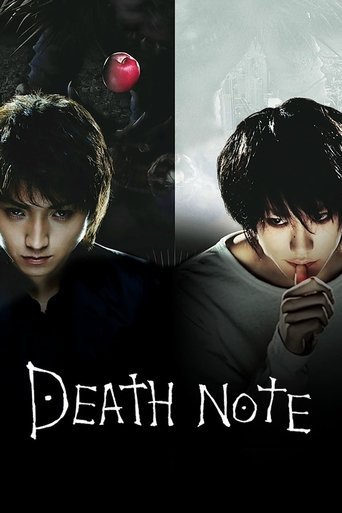
Death Note (2006)
デスノート
The battle of wits begins. Whose side are you on?
Light Yagami finds the "Death Note," a notebook with the power to kill, and decides to create a Utopia by killing the world's criminals, and soon the world's greatest detective, "L," is hired to find the mysterious murderer. An all out battle between the two greatest minds on earth begins and the winner will control the world.
- Date of release
- 2006-06-17
- TMDB
- 7.1 / 10 (851)
- Runtime
- 2h 6m
- Genres
- Fantasy, Mystery, Thriller
- Director
- Shusuke Kaneko
- Collection
- Death Note Collection
Casting
- Tatsuya Fujiwara — Light Yagami
- Kenichi Matsuyama — L
- Asaka Seto — Naomi Misora
- Shigeki Hosokawa — Raye Iwamatsu
- Erika Toda — Misa Amane
- Shunji Fujimura — Watari
- Takeshi Kaga — Soichiro Yagami
- Yuu Kashii — Shiori Akino
- Shidou Nakamura — Ryuk (voice)
- Sota Aoyama — Touta Matsuda
- Norman England — FBI Agent
- Godai Michiko — Sachiko Yagami
Interesting facts
- Box office: $31.3M
- Based on: Death Note
- Awards: 1 · Nominations: 0
Death Note is a 2006 Japanese supernatural thriller film directed by Shusuke Kaneko. It is based on the manga series of the same title by Tsugumi Ohba and Takeshi Obata. The film primarily centers on a Tokyo college student who attempts to change the world into a utopian society without crime, by committing a worldwide massacre of criminals and people whom he deems morally unworthy of life, through a supernatural notebook that kills anyone whose name is written in its pages, while being hunted down by an elite task force of law enforcement officers within Tokyo, led by an enigmatic international detective.
Production
In his production notes, director Shusuke Kaneko explained his desire to convince audiences that, while the killing of bad humans may seem to be fair, it underestimates the corrupting influence of wielding such power (the manga series follows a very similar viewpoint). Kaneko also commented that the psychological fear of dying could be "more nightmarish than Kaiju (monsters) destroying cities and killing people".
Kaneko also stated that he wanted the film to "focus on psychological pain", explain how the deaths occur, and explain how younger people would begin to like Kira. He also removed many of the interior monologues prominent in the manga and anime to allow audiences to develop their own ideas about the characters' thoughts and beliefs, while allowing "dramatic tension".
Kaneko said that the most difficult portion of the manga to film was the scene when the investigation begins and the authorities conclude that a person is responsible for the killing of criminals. He chose to add a scene in which L explains his logic via his laptop in order to make the film "more believable" and "excite people" for the coming struggle between L and Light.
Kaneko indicated mixed feelings while directing the movie. He said that he felt "a little reservation" at how the movie would perform, since the film "uses 'death' to entertain the audience" and feels "morally unsettling". Kaneko theorized that the film may have performed well because of the Internet culture of Japan, saying that the use of the Death Note had similarities to how users attacked one another on message boards and blogs.
The owner of the Death Note copyright required Kaneko to not change any of the rules of the Death Note, and as the film was developed, new rules of the Death Note were added in the original manga. Kaneko described adhering to this condition as the most difficult aspect of making the film.
Read on Wikipedia · Text from Wikipedia, CC BY-SA 4.0. Data from Wikidata.
Recommended
- Death Note: The Last Name 2006 · ★ 7.1
- Nightmare Detective 2007 · ★ 6.1
- Death Note Relight 1: Visions of a God 2007 · ★ 7.9
- Rage 2016 · ★ 6.9
- The Accountant² 2025 · ★ 7.1
- Character 2021 · ★ 7.4
- Death Note Relight 2: L's Successors 2009 · ★ 7.5
- The Client 1994 · ★ 6.7
- The Number 23 2007 · ★ 6.4
- Stay 2005 · ★ 6.6
- The World of Kanako 2014 · ★ 6.4
- The Ritual Killer 2023 · ★ 5.8