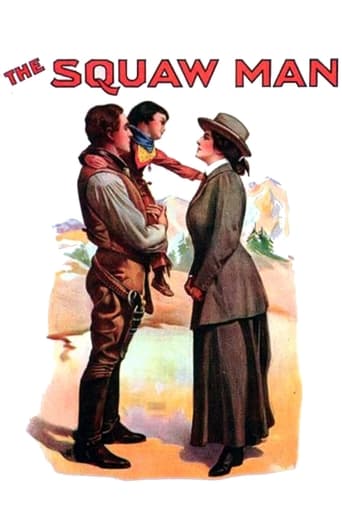
The Squaw Man (1914)
To save his family from disgrace, Capt. James Wynnegate takes the blame when his brother, Sir Henry, embezzles from a charitable fund. Relocating to America, James purchases a ranch in Wyoming and marries Nat-u-ritch, an indigenous woman. After the birth of the couple's son, James is startled by the arrival of Lady Diana, his brother's wife, who informs him that the nefarious Henry is dead.
- Date of release
- 1914-02-15
- TMDB
- 6.0 / 10 (23)
- Runtime
- 1h 14m
- Genres
- Drama, Western
- Director
- Cecil B. DeMille, Oscar Apfel
Casting
- Dustin Farnum — Capt. James Wynnegate
- Monroe Salisbury — Sir Henry - Earl of Kerhill
- Winifred Kingston — Lady Diana
- Lilian St. Cyr — Nat-U-Rich
- Mrs. A.W. Filson — The Dowager Lady Elizabeth Kerhill
- Haidee Fuller — Lady Mabel Wynnegate
- Foster Knox — Sir John
- Richard L'Estrange — Grouchy
- Jack Ellis — Parker
- Raymond Hatton — Cowhand (uncredited)
- Hal Roach — Townsman (uncredited)
- Fernando Gálvez — Sir John Applegate
Interesting facts
- Based on: The Squaw Man
- Filmed in: Lasky-DeMille Barn
The Squaw Man is a 1914 American silent Western film directed by Cecil B. DeMille and Oscar C. Apfel, and starring Dustin Farnum. It was DeMille's directorial debut and the first feature-length film to be shot in what is now Hollywood.
Production background
The only onscreen filmmaking credit is "Picturized by Cecil B. DeMille and Oscar C. Apfel." The film was adapted by DeMille and Apfel from the 1905 stage play of the same name by Edwin Milton Royle, and produced by DeMille, Apfel, and Jesse L. Lasky for the Jesse L. Lasky Feature Play Company, its first film.
This first screen version of the story was the legendary DeMille's first movie assignment. It was also the first feature-length film shot in California, partly in what became Hollywood. Film historians agree that shorts had previously been filmed in Hollywood, with D. W. Griffith's In Old California (1910) considered the earliest.
DeMille wanted to emphasize the outdoors and wanted to shoot the movie in exotic scenery and great vistas. Initially he traveled to Flagstaff, Arizona to film the movie. After seeing the vast amount of mountains near Flagstaff, the production was moved to Los Angeles. Harbor scenes were shot in San Pedro, California and the western saloon set was built beside railroad tracks in the San Fernando Valley.
The Squaw Man went on to become the only movie successfully filmed three times by the same director/producer, DeMille. He filmed a silent remake in 1918, and a talkie version in 1931. The Squaw Man was 74 minutes long and generated $244,700 in profit.
Read on Wikipedia · Text from Wikipedia, CC BY-SA 4.0. Data from Wikidata.
Recommended
- True Grit 1969 · ★ 7.3
- Don't Come Knocking 2005 · ★ 6.2
- No Name on the Bullet 1959 · ★ 6.6
- Little Lord Fauntleroy 1980 · ★ 7.3
- Union Pacific 1939 · ★ 6.7
- Cigarettes & Coffee 1993 · ★ 6.6
- Sergeant Rutledge 1960 · ★ 7.0
- Hombre 1967 · ★ 7.1
- The Last Sunset 1961 · ★ 6.8
- Plunder Road 1957 · ★ 6.9
- Bad Day at Black Rock 1955 · ★ 7.3
- The Proud Rebel 1958 · ★ 6.0