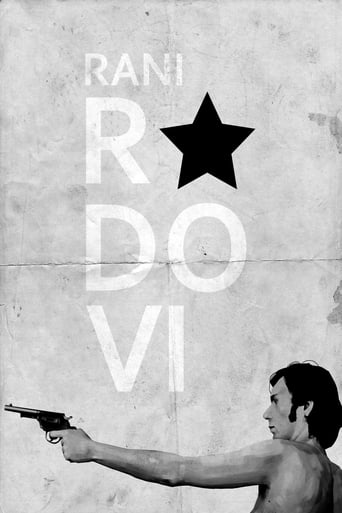
Obras tempranas (1971)
Рани радови
En esta película de corte político y de clara propaganda antistalinista tras la invasión rusa en 1968, un grupo de apasionados comunistas vagabundea por el campo difundiendo las ideas marxistas. Este film tuvo problemas con la censura, justamente porque “una gran parte de público, inocentemente, no se dio cuenta de que los monólogos a modo de eslogan de la mujer que lidera el grupo se habían tomado al pie de la letra de las apasionadas cartas de Marx a Arnold Ruge de 1843 (publicadas con el mismo título que la película), y de fuentes como el Manifiesto comunista”. (FILMAFFINITY)
- Fecha de estreno
- 1971-03-12
- TMDB
- 5.9 / 10 (10)
- Duración
- 1 h 27 min
- Géneros
- Drama
- Director
- Želimir Žilnik
Reparto
- Milja Vujanović — Jugoslava
- Bogdan Tirnanić — Marko
- Čedomir Radović — Kruno
- Marko Nikolić — Dragiša
- Slobodan Aligrudić
- Želimira Žujović
- Dragoslav 'Dragan' Nikolić — (voice)
Curiosidades
- Premios: 1 · Nominaciones: 0. Incluyendo: Oso de oro
Early Works is a 1969 Yugoslav film by Serbian author Želimir Žilnik. It critically depicts the aftermath of the 1968 student demonstrations in Yugoslavia. It won the Golden Bear at the 19th Berlin International Film Festival in 1969. The film belongs to the Yugoslav Black Wave movement.
Background
Žilnik found inspiration the previous year in the stormy worldwide student demonstrations that had their reflection in Yugoslavia at the time, as well as the Soviet invasion of Czechoslovakia and the suppression of the Prague Spring, which prompted him to seriously question the gap between the high ideals of the official Marxist ideology and its application in practice.
The title was borrowed from the popular anthology of the early work by Marx and Engels published first in Yugoslavia in 1953. These early texts had a significant influence on the development of the Yugoslav Praxis School of philosophy.
Žilnik expressed his attitude by creating a strong contrast between the young, idealistic protagonists who fanatically adhere to Marxist principles and the far more banal and prosaic reality in the rural areas of Vojvodina at the time, i.e. through the presentation of the conflict between ideals and reality, which turns into a darkly humorous grotesque.
Žilnik originally planned to direct a sequel entitled Capital, which was supposed to be inspired by Marx's work of the same name, but instead became the subject of official condemnations, and was expelled from the Party and forced to live as an émigré in West Germany for a while.
Leer en Wikipedia · Texto de Wikipedia, CC BY-SA 4.0. Datos de Wikidata.
Recomendadas
- Born in Flames 1983 · ★ 6.2
- Bastard Out of Carolina 1996 · ★ 7.1
- Lucky Them 2013 · ★ 6.0
- La casa de Carroll Street 1988 · ★ 5.9
- La joven 1960 · ★ 7.0
- O.G. 2018 · ★ 5.9
- Salomé 2013 · ★ 6.1
- Xiu Xiu: The sent down girl 1998 · ★ 7.2
- La extraordinaria vida de Eleanor 2025 · ★ 6.8
- Papa está en viaje de negocios 1985 · ★ 7.3
- Strange Weather 2016 · ★ 5.9
- El último refugio 2025 · ★ 6.6