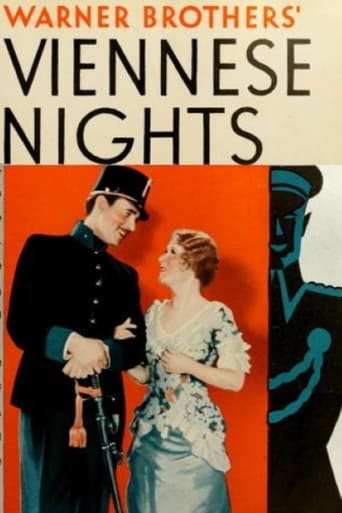
Viennese Nights (1930)
In 1890, Gus Sascher joins the Austrian Army and romances the impoverished girl Elsa Hofner. Her father, meanwhile, in an attempt at social climbing, pushes her towards wealthy officer, Franz von Renner.
- Date of release
- 1930-11-25
- TMDB
- 6.0 / 10 (2)
- Runtime
- 1h 56m
- Genres
- Music, Romance
- Director
- Alan Crosland
Casting
- Vivienne Segal — Elsa Hofner
- Alexander Gray — Otto Stirner
- Jean Hersholt — Herr Hofner, Elsa's Father
- Walter Pidgeon — Franz von Renner
- Louise Fazenda — Gretl Kruger
- Bert Roach — Gus Sascher
- Alice Day — Barbara, Elsa's Granddaughter
- Philipp Lothar Mayring — Baron von Renner, Franz' Father
- June Purcell — Mary, a Singer on the Stage
- Milt Douglas — Bill Jones, a Stage Performer
- Bela Lugosi — Count von Ratz--Hungarian Ambassador
- Mary Treen — Shocked Woman on Street (uncredited)
Interesting facts
Viennese Nights is a 1930 American all-talking pre-Code musical operetta film directed by Alan Crosland and starring Alexander Gray, Vivienne Segal, Walter Pidgeon, Jean Hersholt, Bela Lugosi and Louise Fazenda. It was photographed entirely in Technicolor and released by Warner Bros. Pictures. Viennese Nights was the first original operetta written especially for the screen by Oscar Hammerstein II and Sigmund Romberg. It was filmed in March and April 1930, before anyone realized the extent of the economic hardships that would arrive with the Great Depression, which had begun in the autumn of the previous year.
Production
Viennese Nights was the first of four original screen musicals that the team of Sigmund Romberg and Oscar Hammerstein II were to create for Warner Brothers over a two-year period. They were to be paid $100,000 a piece per film against 25 percent of the profits. This deal was made early in 1930, before anyone realized that the Great Depression would be imminent later that year.
The picture marked Broadway star Vivienne Segal's last starring role in a picture. Segal, who was a star on the stage, was trying to be groomed by Warner Brothers as a competitor to Paramount Pictures' Jeanette MacDonald. Segal's last picture was as a supporting player in MGM's The Cat and the Fiddle, ironically with MacDonald as the star. Viennese Nights also marked operetta singer Alexander Gray's last starring role in a feature.
Among the players, Bela Lugosi makes his first appearance in color in this feature in a bit part as a Hungarian ambassador named Count von Ratz. Lugosi's part was filmed before his claim to fame as the title role in Dracula for Universal Pictures.
Due to the lack of sets, a number of scenes were filmed at other studios, a common practice at that point. The climax of the picture, when the symphony is played, was shot on Universal Picture's Stage 28 theater set, originally built for the Lon Chaney picture The Phantom of the Opera. Viennese Nights marks the third time the set was photographed in Technicolor, the first two being Phantom and The King of Jazz.
Read on Wikipedia · Text from Wikipedia, CC BY-SA 4.0. Data from Wikidata.
Recommended
- Brigadoon 1954 · ★ 6.6
- Love in Winterland 2020 · ★ 6.6
- Roustabout 1964 · ★ 6.0
- Sisters of the Groom 2017 · ★ 6.5
- Forever in My Heart 2019 · ★ 6.8
- Love Struck Café 2017 · ★ 6.4
- Christmas On My Mind 2019 · ★ 6.4
- Salsa 1988 · ★ 6.9
- A Royal Winter 2017 · ★ 7.1
- Press Play 2022 · ★ 6.4
- Apple Music Live: Lady Gaga MAYHEM Requiem 2026 · ★ 8.3
- Make Mine Music 1946 · ★ 5.8