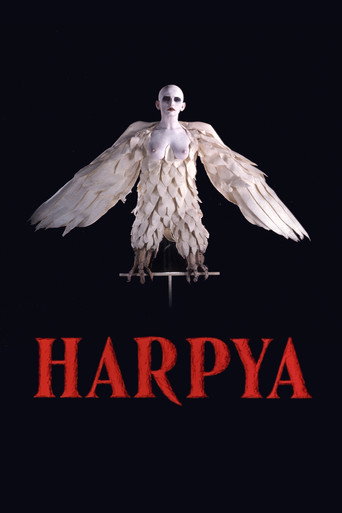
Harpy (1979)
Harpya
An unknowing man rescues a rather aggressive and demanding harpy.
- Date of release
- 1979-05-01
- TMDB
- 6.4 / 10 (46)
- Runtime
- 9m
- Genres
- Animation, Comedy, Fantasy, Horror
- Director
- Raoul Servais
Casting
- Will Spoor — Man
- Fran Waller Zeper — Harpy
- Sjoert Schwibethus — Assailant
Interesting facts
- Awards: 1 · Nominations: 0. Including: Short Film Palme d'Or
Harpya is a 1979 Belgian short comedy horror film written and directed by Raoul Servais, which tells the story of a man who tries to live with a harpy, a mythical being that is half woman and half bird of prey with an insatiable appetite. The nine-minutes-long film, which has no spoken dialogue, explores authority and domination, themes Servais had earlier addressed on a larger, societal level but here applied to a personal relationship.
Production
Servais was established as a central figure in Belgian animation before he made Harpya. He made his first animated short film in 1959 and taught animation at the Royal Academy of Fine Arts in Ghent from 1966. In 1969, he co-founded the animation studio Pen-Film and in 1976, he co-created the Belgisch Animatiefilmcentrum (lit. 'Belgian Animation Film Centre').
Servais came up with the story for Harpya after repeatedly waking up from nightmares one night. He envisioned it as a comedy horror film about a harpy. Harpies are for example known from the Greek poem Argonautica, which tells the story of Phineus, a cursed king tormented by harpies who stole his food and brought him to near starvation. Harpya is the third film, following Siren and Pegasus (1973), for which Servais drew material from mythology.
Harpya marked a new technical development in Servais' career because it was the first time he combined animation with live actors. There are three actors in the film: Will Spoor as the man, Fran Waller Zeper as the harpy and Sjoert Schwibethus as the assailant.
Servais and the cinematographer Walter Smets filmed the actors at 24 frames per second against a black velvet background. The scene in which characters appear to move without using their legs was created by digging a ditch. For the animation part of the production, Servais created silhouette shapes made of Scotchlite corresponding to each frame of the actors.
Servais says Harpya was visually influenced by the works of Flemish expressionist painters. Others have described it as being influenced by surrealist paintings, especially those of René Magritte, for whom Servais had worked in the 1950s. According to the journalist Wim de Poorter of Ons Erfdeel, the influence from Magritte is apparent in Harpya's sober scenery, soft colours and shadows in moonlight.
Read on Wikipedia · Text from Wikipedia, CC BY-SA 4.0. Data from Wikidata.
Recommended
- Cranston Academy: Monster Zone 2020 · ★ 6.0
- Wendell & Wild 2022 · ★ 6.6
- Don't Hug Me I'm Scared 6 2016 · ★ 8.0
- Chickenhare and the Hamster of Darkness 2022 · ★ 7.2
- Hulk vs. Wolverine 2009 · ★ 7.1
- The Spine of Night 2021 · ★ 6.0
- Stewie Griffin: The Untold Story 2005 · ★ 6.9
- LEGO Marvel Avengers: Mission Demolition 2024 · ★ 6.5
- Marvel One-Shot: All Hail the King 2014 · ★ 6.8
- Invader Zim: Enter the Florpus 2019 · ★ 7.4
- Abraham Lincoln Vampire Hunter: The Great Calamity 2012 · ★ 8.1
- Yellow Mirror 2026 · ★ 8.1