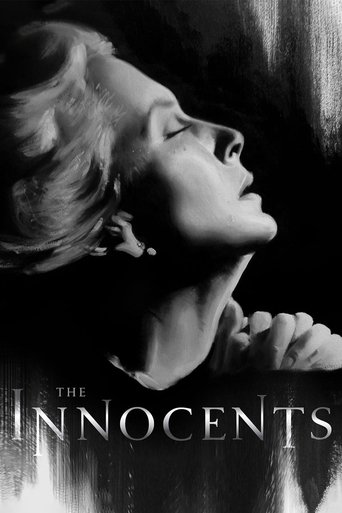
The Innocents (1961)
Apparitions? Evils? Corruptions?
In a mid-19th century Essex country house, a young governess for two children becomes convinced that the house and grounds are haunted by ghosts and that the children are being possessed.
- Date of release
- 1961-11-24
- TMDB
- 7.5 / 10 (712)
- Runtime
- 1h 40m
- Genres
- Horror, Mystery
- Director
- Jack Clayton
Casting
- Deborah Kerr — Miss Giddens
- Peter Wyngarde — Peter Quint
- Megs Jenkins — Mrs. Grose
- Michael Redgrave — The Uncle
- Martin Stephens — Miles
- Pamela Franklin — Flora
- Clytie Jessop — Miss Jessel
- Isla Cameron — Anna
- Eric Woodburn — Coachman (uncredited)
Interesting facts
- Box office: $1.2M
- Budget: £430K
- Based on: The Turn of the Screw and The Innocents
- Awards: 1 · Nominations: 0. Including: National Board of Review: Top Ten Films
The Innocents is a 1961 gothic psychological horror film directed and produced by Jack Clayton, and starring Deborah Kerr, Michael Redgrave, and Megs Jenkins. Based on the 1898 novella The Turn of the Screw by the novelist Henry James, the screenplay was adapted by William Archibald and Truman Capote, who used Archibald's own 1950 stage play—also titled The Innocents—as a primary source text. Its plot follows a governess who watches over two children and comes to fear that their large estate is haunted by ghosts and that the children are being possessed.
Production
The original screenplay for The Innocents was adapted by playwright William Archibald from his 1950 play of the same name, which itself was based on Henry James's novella The Turn of the Screw. In both his stage and screen adaptations, Archibald wrote under the assumption that the supernatural experiences of Miss Giddens were real, and that the ghosts she encountered were legitimate entities as opposed to figments of her imagination (a possibilit…
comprises a montage of images superimposed over [Miss Giddens's] reclining figure—the cracked photograph of Quint, Quint on the tower, Flora's hand holding her pet tortoise, a musical box trilling "O Willow Waly." The dream ends with Miss Giddens imagining how the children have been possessed by Miss Jessel...dancing in silhouette with Flora, Quint putting a possessive arm over Miles's shoulder, and Miss Giddens herself praying for deliverance to…
Director Jack Clayton envisioned a more ambiguous conclusion for the film: "My original interest in the story was in the fact that one could tell it from a completely different point of view," he said. "In other words–evil was alive in the mind of the governess and in fact she more or less creates the situation.
Clayton was ultimately unhappy with Archibald's screenplay due to their conflicting interpretations of the material, and asked American writer Truman Capote (whom he had met while working on Beat the Devil) to rework Archibald's script. At the time, Capote was in the middle of writing In Cold Blood; however, because he was a fan of the James novella, he agreed, and took a three-week hiatus to rewrite the screenplay.
Cultural critic Christopher Frayling attributes approximately 90% of the film's script as it appears on the screen to Capote (The final credits attribute the screenplay to Archibald and Capote, with Mortimer receiving credit for "Additional Scenes and Dialogue").
Read on Wikipedia · Text from Wikipedia, CC BY-SA 4.0. Data from Wikidata.
Recommended
- Mostly Ghostly 3: One Night in Doom House 2016 · ★ 6.2
- The Cellar 2022 · ★ 6.4
- Burnt Offerings 1976 · ★ 6.4
- The Witches 1990 · ★ 7.0
- Nightbooks 2021 · ★ 6.1
- The Watcher in the Woods 1980 · ★ 5.9
- Mr. Boogedy 1986 · ★ 6.3
- Twice-Told Tales 1963 · ★ 6.2
- Nancy Drew and the Hidden Staircase 2019 · ★ 6.3
- Next of Kin 1982 · ★ 6.2
- Silver Bullet 1985 · ★ 6.7
- The Hound of the Baskervilles 1983 · ★ 6.5