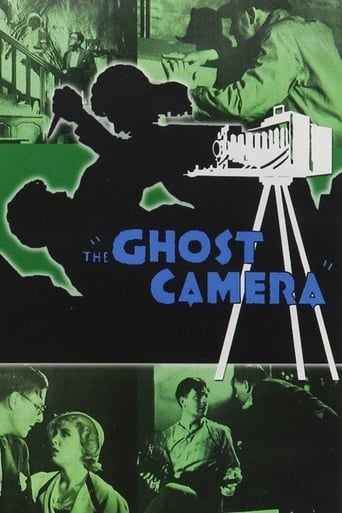
The Ghost Camera (1933)
Lorsqu'une photographie est prise sur les lieux d'un meurtre, l'appareil est jeté par la fenêtre d'un château pour détruire les preuves et atterrit à l'arrière de la voiture du chimiste John Gray, qui, après avoir développé la pellicule, se transforme en détective amateur et part à la recherche de la femme photographiée. Le vol de l'appareil dans son laboratoire alimente encore davantage les soupçons de Gray.
- Date de sortie
- 1933-01-31
- TMDB
- 6.3 / 10 (17)
- Durée
- 1 h 5 min
- Genres
- Comédie, Thriller, Romance, Mystère, Crime
- Réalisateur
- Bernard Vorhaus
Distribution
- Henry Kendall — John Gray
- Ida Lupino — Mary Elton
- Victor Stanley — Albert Sims
- John Mills — Ernest Elton
- George Merritt — Police Detective
- Felix Aylmer — Coroner
- Fred Groves — Barnaby Rudd
- Charles Paton — Farmer
- Tom Shenton — Police Officer
- Davina Whitehouse — Amelia Wilkinson, the Maid
Anecdotes
The Ghost Camera is a 1933 British mystery film directed by Bernard Vorhaus, starring Henry Kendall, Ida Lupino and John Mills. It was written by H. Fowler Mear based on "A Mystery Narrative", a short story by Joseph Jefferson Farjeon, and was made as a quota quickie.
Production
The film was made at Julius Hagen's Twickenham Studios as part of a long-term contract to provide films for the American major studio RKO enabling it to comply with the terms of the Cinematograph Films Act 1927. Most such films were cheaply made supporting features which became known as "quota quickies". Hagen's Twickenham company developed a reputation as a leading producer of popular quota quickies.
The film's director, Bernard Vorhaus, had arrived in Britain from America in 1930 and established himself as a director of quota films in Britain's rapidly growing film industry. His films became notable for featuring rapid editing (he often used the young David Lean as editor, who claimed that Vorhaus was a major early influence on him) and location shooting, both of which were relatively rare for supporting films.
Lire sur Wikipédia · Texte de Wikipédia, CC BY-SA 4.0. Données de Wikidata.
Recommandés
- Breathless 2012 · ★ 5.9
- Ca$h 2010 · ★ 5.9
- Le Murder Club du jeudi 2025 · ★ 6.6
- Meurtre en musique 1947 · ★ 6.7
- Absolution 2024 · ★ 5.9
- Une journée de fous 1989 · ★ 6.1
- La brune de mes rêves 1947 · ★ 6.6
- Divine mais dangereuse 2001 · ★ 5.9
- Cleaner 2007 · ★ 6.1
- Drôle d'embrouille 1978 · ★ 6.3
- Overdrive 2017 · ★ 6.1
- All the Devils Are Here 2025 · ★ 6.2