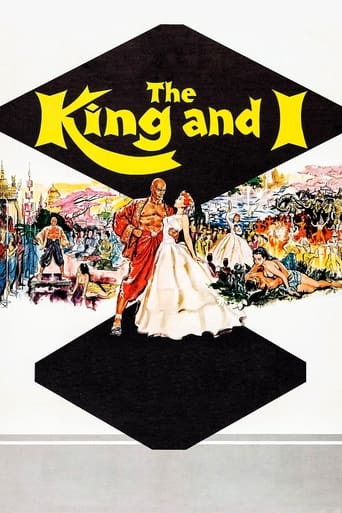
The King and I (1956)
More than your eyes have ever seen… More than your heart has ever known!
Widowed Welsh mother Anna Leonowens becomes a governess and English tutor to the wives and many children of the stubborn King Mongkut of Siam. Anna and the King have a clash of personalities as she works to teach the royal family about the English language, customs and etiquette, and rushes to prepare a party for a group of European diplomats who must change their opinions about the King.
- Date of release
- 1956-06-29
- TMDB
- 7.1 / 10 (423)
- Runtime
- 2h 13m
- Genres
- Romance, History, Drama
- Director
- Walter Lang
Casting
- Deborah Kerr — Anna Leonowens
- Yul Brynner — King Mongkut of Siam
- Rita Moreno — Tuptim
- Martin Benson — Kralahome
- Terry Saunders — Lady Thiang
- Rex Thompson — Louis Leonowens
- Carlos Rivas — Lun Tha
- Patrick Adiarte — Prince Chulalongkorn
- Alan Mowbray — John Hay
- Geoffrey Toone — Edward Ramsay
- Jadin Wong — Amazon (uncredited)
- Jean Wong — Amazon (uncredited)
Interesting facts
- Based on: The King and I and Anna and the King of Siam
- Awards: 6 · Nominations: 10. Including: Academy Award for Best Actor; Academy Award for Best Costume Design, Color; Academy Award for Best Art Direction, Color; Academy Award for Best Original Musical Score
The King and I is a 1956 American musical film made by 20th Century-Fox, directed by Walter Lang and produced by Charles Brackett and Darryl F. Zanuck. The screenplay by Ernest Lehman is based on the 1951 Rodgers and Hammerstein musical The King and I, which is itself based on the 1944 novel Anna and the King of Siam by Margaret Landon. That novel in turn was based on memoirs written by Anna Leonowens, who became school teacher to the children of King Mongkut of Siam in the early 1860s. Leonowens' stories were autobiographical, although various elements of them have been called into question. The film stars Deborah Kerr and Yul Brynner.
Production
The musical was written for Gertrude Lawrence, and her appearance in the film was contractually guaranteed. However, she was diagnosed with cancer while playing the role on Broadway and died during the run. Dinah Shore was considered for the role of Anna in the movie. Maureen O'Hara was originally cast, but Richard Rodgers did not agree to the casting. It was Yul Brynner who pressed for Deborah Kerr to play the role.
Donald Bogle's biography of Dorothy Dandridge claims that Dandridge was offered the role of Tuptim in partial fulfillment of her three-picture contract with 20th Century-Fox, but that Dandridge allowed Otto Preminger (her lover and former director) to dissuade her because it was not the lead role. Rumors also circulated that Dandridge, as an African American, did not want to play a slave.
Reprising their Broadway stage roles, Saunders plays Thiang, Adiarte plays Chulalongkorn and Benson plays the Kralahome, and dancers Yuriko and de Lappe also reprise their stage roles. Alan Mowbray appears in the new role of the British ambassador, while Sir Edward Ramsey (demoted to the ambassador's aide) is played by Geoffrey Toone. The cinematography was by Leon Shamroy, the art direction by John DeCuir and Lyle R.
Three songs from the original stage production were recorded for, and appeared on, the film's soundtrack but do not appear in the motion picture: "Shall I Tell You What I Think of You?", "I Have Dreamed" and "My Lord and Master". "I Have Dreamed" and another song that was not used in the film, "Western People Funny", survive in the released film only as orchestral underscoring.
A special 50th-anniversary edition was released in 2006, which promised to restore the lost numbers, but it included only the audio and some still photographs for "Shall I Tell You?", casting doubt on the existence of footage of these numbers. An off-screen choral reprise of "Something Wonderful" was added to serve as the film's finale; the stage version ends with musical underscoring, but no singing.
Read on Wikipedia · Text from Wikipedia, CC BY-SA 4.0. Data from Wikidata.
Recommended
- Anna and the King of Siam 1946 · ★ 6.2
- Anna and the King 1999 · ★ 6.8
- Persuasion 2007 · ★ 7.2
- Queen Christina 1934 · ★ 6.9
- The Whole Wide World 1996 · ★ 6.6
- The Girl King 2015 · ★ 6.2
- A Letter to Three Wives 1949 · ★ 7.2
- Persuasion 1995 · ★ 7.2
- Sunrise: A Song of Two Humans 1927 · ★ 7.8
- Jane Eyre 1943 · ★ 6.9
- Humoresque 1947 · ★ 7.0
- The Theory of Everything 2014 · ★ 7.8