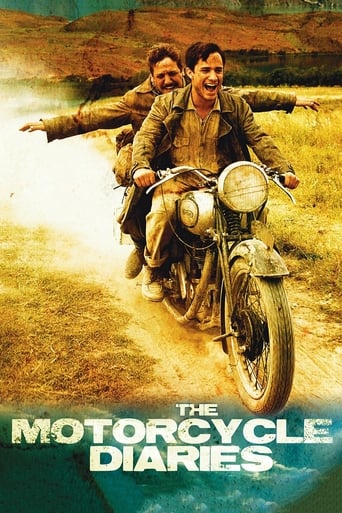
The Motorcycle Diaries (2004)
Diarios de motocicleta
Let the world change you...and you can change the world.
Based on the journals of Che Guevara, leader of the Cuban Revolution. In his memoirs, Guevara recounts adventures he and best friend Alberto Granado had while crossing South America by motorcycle in the early 1950s.
- Date of release
- 2004-02-06
- TMDB
- 7.4 / 10 (1497)
- Runtime
- 2h 6m
- Genres
- Drama
- Director
- Walter Salles
Casting
- Gael García Bernal — Ernesto "Che" Guevara de la Serna
- Rodrigo de la Serna — Alberto Granado
- Mercedes Morán — Celia de la Serna
- Mía Maestro — Chichina Ferreyra
- Jean Pierre Noher — Ernesto Guevara Lynch
- Lucas Oro — Roberto Guevara
- Marina Glezer — Celita Guevara
- Sofia Bertolotto — Ana María Guevara
- Franco Solazzi — Juan Martín Guevara
- Ricardo Díaz Mourelle — Uncle Jorge
- Gustavo Bueno — Dr. Hugo Pesce
- Antonella Costa — Silvia
Interesting facts
- Box office: $57.6M
- Based on: The Motorcycle Diaries
- Filmed in: Buenos Aires, Peru, and Chile
- Awards: 7 · Nominations: 2. Including: Cannes Film Festival; Academy Award for Best Original Song; San Sebastián International Film Festival; British Academy Film Awards
The Motorcycle Diaries is a 2004 biographical coming-of-age road film directed by Walter Salles from a screenplay by José Rivera, based on Che Guevara's 1995 memoir of the same name and Alberto Granado's memoir Che Guevara: The Making of a Revolutionary. The film recounts the 1952 expedition, initially by motorcycle, across South America by Guevara and Granado, observing the life of the impoverished indigenous peasantry. Through the trip, both of them witnessed the social classes struggle in Latin America.
Production
The film shows what we were, which was two young men – boys, really – who went looking for adventure and found the truth and tragedy of our homeland.
Gael García Bernal agreed to reprise his role as young Che Guevara having previously portrayed him in the television film Fidel. To prepare for the role, he went through six months of intense preparation. This groundwork included reading "every biography" about Guevara, traveling to Cuba to speak with Guevara's family, and consulting with Guevara's then still living travel partner Alberto Granado.
Moreover, García Bernal (who is Mexican) adopted an Argentine accent and spent 14 weeks reading the works of José Martí,
Karl Marx and Pablo Neruda (Guevara's favorite poet). García Bernal told reporters "I feel a lot of responsibility. I want to do it well because of what Che represents to the world. He is a Romantic. He had a political consciousness that changed Latin America." According to García Bernal, the role crystallized his "own sense of duty" because Guevara "decided to live on the side of the mistreated, to live on the side of the people who have no just…
Granado later stated that he appreciated the film's effort "to dig beneath the "mythical Che", whose defiant image appears on T-shirts and posters around the world, "to reveal the flawed, flesh-and-blood Ernesto beneath."
Read on Wikipedia · Text from Wikipedia, CC BY-SA 4.0. Data from Wikidata.
Recommended
- Che: Part One 2008 · ★ 6.8
- The Mosquito Coast 1986 · ★ 6.4
- Lord of the Flies 1963 · ★ 6.7
- The Postman 1997 · ★ 6.3
- 2073 2024 · ★ 6.7
- One Week 2008 · ★ 6.8
- Stowaway 2021 · ★ 6.0
- The Giver 2014 · ★ 6.6
- Carmen 2023 · ★ 6.2
- Planet of the Apes 1968 · ★ 7.7
- My Neighbor Adolf 2022 · ★ 6.6
- East of Eden 1955 · ★ 7.5