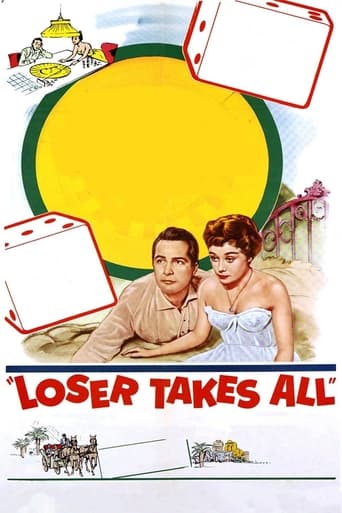
Loser Takes All (1956)
The Warmest, Wonderful-est, WINNING-est romance-of-the-year!
Bertrand, an accountant employed by a large London firm, is called to the office of the Managing Director, Dreuther, to explain a mistake in the accounts. Dreuther is highly impressed by the young accountant's skilful explanation of the error and, hearing that Bertrand is soon to marry his spirited young fiancée, tells him to spend the honeymoon not in Bournemouth, but Monte Carlo at the company s expense! However, events in the fabulous Mediterranean paradise do not work out quite as Bertrand had envisaged...
- Date of release
- 1956-09-09
- TMDB
- 6.0 / 10 (6)
- Runtime
- 1h 28m
- Genres
- Comedy
- Director
- Ken Annakin
Casting
- Glynis Johns — Cary
- Rossano Brazzi — Bertrand
- Robert Morley — Dreuther
- Tony Britton — Philip
- Felix Aylmer — The Other
- Joyce Carey — Bird's Nest
- Geoffrey Keen — Reception Clerk
- Peter Illing — Stranger with "The System"
- Albert Lieven — Hotel Manager
- Mona Washbourne — Nurse (uncredited)
- A.E. Matthews — Man
- Hyma Beckley — Casino Patron (uncredited)
Interesting facts
Loser Takes All is a 1956 British comedy film directed by Ken Annakin, starring Glynis Johns, Rossano Brazzi and Robert Morley. The screenplay was by Graham Greene based on his 1955 novella of the same name.
Production
Ken Annakin had just made a well received film from a Graham Greene story, Across the Bridge, and was allowed to have the film rights to his novella Loser Takes All. He wanted Trevor Howard to play the accountant Tony Bertrand and Orson Welles to play Dreuther, the producer based on Alexander Korda. However Sir Arthur Jarratt, then head of British Lion, refused to finance with either actor, or another suggestion, David Niven as Bertrand.
Richard Todd says he was offered the role of Bertrand. He said "I agreed to do the picture, provided it went into production fairly soon and would not conflict with my next Fox contract film, whatever that would be." However he had to withdraw when the film was delayed.
Graham Greene wrote the script while with Annakin in Monte Carlo. Alec Guinness was offered the role of Dreuther but decided to accept a part in The Swan instead so Robert Morley was cast. According to Annakin, Glynis Johns and Brazzi had an affair during the making of the film which resulted in Johns becoming pregnant.
Annakin wrote the film "was a so-so success, with mixed notices. Despite the wrong casting, the seeds of failure lay in the novel with its ‘topsy-turvy’ moral standpoints. It turned out that although the book was brilliant and funny, cinema audiences had no sympathy for a girl who felt deserted by her husband during the few days he was amassing millions.
Read on Wikipedia · Text from Wikipedia, CC BY-SA 4.0. Data from Wikidata.
Recommended
- Much Ado About Nothing 2013 · ★ 6.8
- Rat Race 2001 · ★ 6.3
- Good Neighbor Sam 1964 · ★ 6.6
- Taking Care of Business 1990 · ★ 6.3
- Jim Jefferies: Freedumb 2016 · ★ 7.2
- The Mouse That Roared 1959 · ★ 6.4
- Beau Hunks 1931 · ★ 6.8
- Monte Carlo or Bust! 1969 · ★ 5.9
- The Ladies Man 1961 · ★ 6.3
- Vegas Vacation 1997 · ★ 6.0
- Room Service 1938 · ★ 6.5
- Phantom of the Megaplex 2000 · ★ 6.1