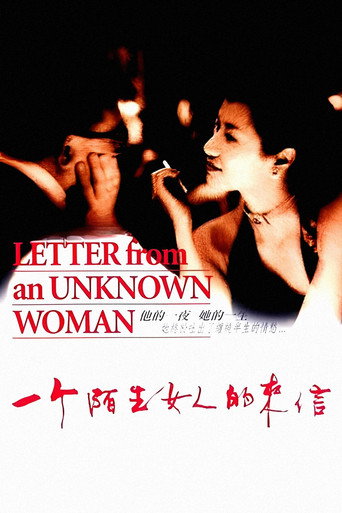
一个陌生女人的来信 (2004)
Peking, 1948. A winter night. A man returns home to find a letter awaiting him written by a woman before her death. in the letter she tells him the story of her love for him -a life-long passion that has not diminished over time, but one that he has never known. her story spans 18 years from the moment she -then a 13 year-old girl- sets her eyes on her new neighbor. she tells their brief but passionate love in her youthi the hardship she goes through raising their child alone, and their final encounter after the war, during which the man fails tor ecognize her and one which leaves her in despair. Now having lost her son, she no longer has the courage to live on. Only in a letter is she capable of telling him everything, for the first and the last time. shaken by the letter, the man searches his memory for the nameless woman.
Besetzung
- 徐静蕾 — Miss Jiang
- Jiang Wen — Mr. Xu
- 黄觉 — Captain Huang
- Lin Yuan — Girl
- Jiao Huang — Officer Huang
- Su Xiaoming — Mother
Wissenswertes
- Basiert auf: Brief einer Unbekannten
Letter from an Unknown Woman is a 2004 Chinese drama film written and directed by Xu Jinglei and is her second feature film as director after 2002's My Father and I. The film is an adaptation of Stefan Zweig's 1922 novella of the same name, which was also adapted in 1948 by screenwriter Howard Koch. The film stars Xu and Jiang Wen as lovers during the 1930s and 1940s in Beijing. It was produced by Asian Union Film & Media.
Production
Originally the film's story was to have taken place in more recent times, spanning the 1970s through the 1990s. However, Xu moved the film's setting several decades back in time, to avoid dealing with social issues such as unmarried mothers and prostitution during the Cultural Revolution that ended in the 1970s, to avoid arousing the suspicions of Chinese censors.
Xu also decided to use Beijing as the primary setting over cities like Shanghai (which she felt was overly colonial), Chongqing, and Nanjing (both of which were too turbulent during the war to adequately serve as the setting for a love story). Additionally, Xu felt that Beijing would offer a distinct visual perspective that would have been absent in other Chinese cities.
Auf Wikipedia weiterlesen · Text aus Wikipedia, CC BY-SA 4.0. Daten aus Wikidata.
Empfohlen
- Buddha Mountain 2011 · ★ 6.7
- Lucky Them 2013 · ★ 6.0
- Strange Weather 2016 · ★ 5.9
- The Girl in the Book 2015 · ★ 5.8
- Schutzlos - Schatten über Carolina 1996 · ★ 7.1
- Anklage: Mord - Im Namen der Wahrheit 2013 · ★ 6.4
- The Safety of Objects 2002 · ★ 6.5
- Die Wurzeln des Glücks 2019 · ★ 6.1
- Linda's Child 2013 · ★ 6.0
- I Believe in Unicorns 2015 · ★ 6.6
- Weiße Zeit der Dürre 1989 · ★ 6.7
- TalhotBlond - Mörderische Lügen 2012 · ★ 6.3