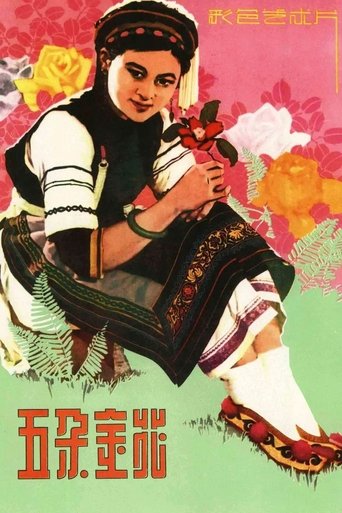
Пять Золотых цветков (1959)
五朵金花
Фильм начинается с того, что А Пэн, юноша из народности бай с юго-запада Китая, едет на фестиваль в город Дали (провинция Юньнань). По пути он встречает Цзиньхуа (что в переводе - Золотой цветок), которой нужна помощь, чтобы починить её повозку. А Пэн помогает ей и позже выигрывает скачки на фестивале. Впечатленная его умением и добротой, Цзиньхуа влюбляется в парня. А Пэн и Цзиньхуа соглашаются встретиться через год, но когда А Пэн через год приезжает, он не может её найти. Он и его товарищи ищут Цзиньхуа и встречают четырёх других женщин по имени Цзиньхуа - сталелитейщицу, трактористку, пастушку и производителя удобрений - прежде чем он в конце концов найдет свою любовь, которая работает заместителем главы коммуны.
- Дата выхода
- 1959-10-01
- TMDB
- 6.9 / 10 (8)
- Длительность
- 1 ч 45 мин
- Жанры
- музыка, мелодрама
- Режиссёр
- Wang Jiayi
В ролях
- Yang Likun — 副社长金花
- Mo Zhijiang — 阿鹏
- Wang Suya — 炼钢厂金花
- Zhu Yijing — 拖拉机金花
- Tan Yaozhong — 畜牧场金花
- Sun Jingzhen — 积肥模范金花
- Huang Zhong — 画家
- Yan Jie — 音乐家
- Xiong Zhang — 管闲事老叔
- Li Wenwei — 爷爷
- Chunying Wang — 炼铁组长
- Guizhen Yang — 小花
Интересные факты
Five Golden Flowers is a 1959 Chinese romantic musical film directed by Wang Jiayi and produced by Changchun Film Studio. The screenplay was written by Zhao Jikang and Wang Gongpu. Set in the Dali City in Yunnan Province, the film is about a Bai ethnic youth, Ah Peng, searching for his beloved ethnic girl Jin Hua. Made during the Great Leap Forward, the film celebrates socialist construction and agricultural collectivization. The theme song of the film "By the Butterfly Spring," composed by musician Lei Zhenbang, was one of the most well-known folk songs in China. The film was produced and released in 1959.
Production
In 1958, Changchun Film Studio's workshops and canteens all turned into studios. Big-character posters that discussed film scripts were hung on every wall. In the same year, Changchun Film Studio launched 31 "satellite" films. No one dared to say anything about the poor artistic quality of those films, because saying that demonstrated an "incorrect attitude" (taidu wenti) and "incorrect standpoint" (lichang wenti).
The Central Secretariat in 1958 pointed out that the film production in 1959 shouldered the task of producing "gift presentation films" (xianli pian) for the tenth anniversary of the founding of the PRC. Xia Yan, who was appointed in 1954 as Vice Minister of Culture, made a report on "gift presentation films" in 1958.
After viewing several gift presentation films, Zhou Enlai was disappointed that they lacked "a sense of beauty, joviality and vivacity". He suggested Xia Yan find a joyful and lighthearted subject matter. To break from the serious topics dealing with revolutionary and war, Xia Yan instructed the Propaganda Department of the Yunnan Provincial Committee to produce a comedy film that features singing and dancing and the picturesque landscape in Yunn…
The screenplay, written by Zhao Jikang and Wang Gongpu, was originally titled Duoduo Jinhua and featured twelve golden flowers. After reading, Xia Yan reduced the number of golden flowers to five. Xia Yan in his comments on the script encouraged the scenarist to liberate their thoughts and try to keep the story entertaining. Five Golden Flowers was made with an "international imagination".
Читать в Википедии · Текст из Википедии, CC BY-SA 4.0. Данные Викиданных.
Рекомендуем
- Salsa 1988 · ★ 6.9
- Разнорабочий 1964 · ★ 6.0
- Бригадун 1954 · ★ 6.6
- Время между нами 2022 · ★ 6.4
- Частоты любви 2013 · ★ 6.6
- Apple Music Live: Lady Gaga MAYHEM Requiem 2026 · ★ 8.3
- Sisters of the Groom 2017 · ★ 6.5
- Летние гастроли 1950 · ★ 6.7
- Девушка, которая украла время 2025 · ★ 9.0
- The Matchmaker's Playbook 2018 · ★ 7.2
- Щелкунчик 1993 · ★ 5.8
- Пока мы не встретимся вновь 2021 · ★ 6.6