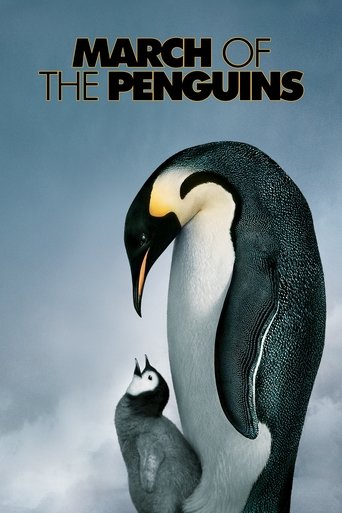
March of the Penguins (2005)
La Marche de l'empereur
In the harshest place on Earth, love finds a way.
Every year, thousands of Antarctica's emperor penguins make an astonishing journey to breed their young. They walk, marching day and night in single file 70 miles into the darkest, driest and coldest continent on Earth. This amazing, true-life tale is touched with humour and alive with thrills. Breathtaking photography captures the transcendent beauty and staggering drama of devoted parent penguins who, in the fierce polar winter, take turns guarding their egg and trekking to the ocean in search of food. Predators hunt them, storms lash them. But the safety of their adorable chicks makes it all worthwhile. So follow the leader... to adventure!!
- Date of release
- 2005-01-26
- TMDB
- 7.1 / 10 (1270)
- Runtime
- 1h 20m
- Genres
- Documentary, Family
- Director
- Luc Jacquet
- Collection
- March of the Penguins Collection
Casting
- Charles Berling — Father Penguin (voice)
- Romane Bohringer — Mother Penguin (voice)
- Jules Sitruk — Baby Penguin (voice)
- Morgan Freeman — Narrator
Interesting facts
- Awards: 1 · Nominations: 1. Including: Academy Award for Best Documentary Feature Film
March of the Penguins is a 2005 French nature documentary film directed and written by Luc Jacquet. The documentary depicts the yearly journey of the emperor penguins of Antarctica. In autumn, all the penguins of breeding age leave the ocean, which is their normal habitat, to walk inland to their ancestral breeding grounds. There, the penguins participate in a courtship that, if successful, results in the hatching of a chick. For the chick to survive, both parents must make multiple arduous journeys between the ocean and the breeding grounds over the ensuing months.
Production
The DVD version includes a 54-minute film entitled Of Penguins and Men made by the film crew Laurent Chalet and Jérôme Mason about the filming of March of the Penguins.
Director and film crew spent more than 13 months at the Dumont d'Urville Station, where the Institut polaire français Paul-Émile Victor is based. Although the penguins' meeting place, one of four in Antarctica, was known to be near, the day on which it occurs is not known, so they had to be ready every day. Fortunately, the gathering that year was huge – more than 1,200 penguins, compared with the norm of a few hundred.
For cameras to operate at −40°, they had to use film and to load all the film for the day, as it was impossible to reload outside. Because of the isolation from any film studios, remembering each shot was necessary to ensure continuity and to make sure that all the necessary sequences were finished.
The main challenge of making the documentary was the weather with temperatures between −50 and −60 °C (−58 and −76 °F). At dawn, the film crew would spend half an hour putting on six layers of clothes, and on some days they could not spend more than three hours outside. They worked in winds with gusts up to 125 miles per hour, "which in some ways is worse than the cold temperatures" according to director Jacquet.
Read on Wikipedia · Text from Wikipedia, CC BY-SA 4.0. Data from Wikidata.
Recommended
- Penguins 2019 · ★ 7.1
- March of the Penguins 2: The Next Step 2017 · ★ 6.9
- Polar Bear 2022 · ★ 7.2
- A Reindeer's Journey 2018 · ★ 6.5
- Dolphin Reef 2018 · ★ 6.8
- The Elephant Queen 2019 · ★ 7.3
- Chimpanzee 2012 · ★ 7.0
- Whispers in the Woods 2025 · ★ 7.9
- The Endurance 2000 · ★ 6.9
- Born to Be Wild 2011 · ★ 7.0
- Encounters at the End of the World 2008 · ★ 7.5
- Pandas 2018 · ★ 7.9