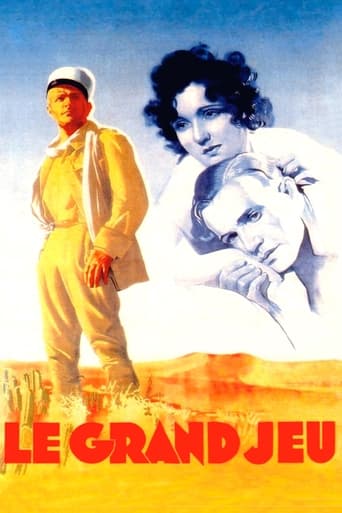
The Great Game (1934)
Le Grand Jeu
Pierre , a young lawyer, has enormous debts due to his mistress Florence and her whims of luxury life. Pierre has gone too far and put the family firm in jeopardy. They ask him to expatriate. To avoid scandal, Pierre joins the Foreign Legion. In Morocco, near the desert, Pierre goes with his comrades of the Legion to a bar-restaurant-brothel, owned by a shady character, Mr. Clement . Clement lives more or less with Ms.Blanche who is a fortune teller with cards, as a hobby. But Clement is also after his girls now and then. Pierre is still obsessed with Florence but he meets Irma , one of Clement's girls, who is the double of Florence except for hair color. Irma has had an accident and has lost part of her memory at a certain point of her recent past, and Pierre slowly persuades himself she is Florence, but cannot remember it. Advised by Ms.Blanche, Irma finally accepts to act as if she was Florence because she is falling in love with Pierre.
- Date of release
- 1934-05-02
- TMDB
- 7.1 / 10 (14)
- Runtime
- 1h 50m
- Genres
- Drama
- Director
- Jacques Feyder
Casting
- Marie Bell — Florence / Irma
- Pierre Richard-Willm — Pierre Martel / Pierre Muller
- Charles Vanel — Clement
- Georges Pitoeff — Nicolas Ivanoff
- Camille Bert — Le colonel
- André Dubosc — Bernard Martel
- Pierre Larquey — Gustin
- Lyne Clevers — La môme Dauville
- Harry Nestor — Aziani
- Pierre de Guingand — Le capitaine
- Louis Florencie — Fenoux
- Pierre Labry — Le cantinier
Interesting facts
Le Grand Jeu is a 1934 French drama film directed by Jacques Feyder and starring Pierre Richard-Willm, Marie Bell, Charles Vanel and Françoise Rosay. It is a romantic drama set against the background of the French Foreign Legion, and the film was an example of poetic realism in the French cinema. The title Le Grand Jeu refers to the practice of reading the cards. Blanche asks whether her client wants the 'full works', the whole story: "Alors... je te fais le grand jeu?"
Production
Jacques Feyder had been working in Hollywood since 1929. However, in 1932, when he and MGM failed to reach an agreement on any new projects, he returned to France. One of his last unrealized projects in Hollywood had been to direct Greta Garbo in an adaptation of Pirandello's Come tu mi vuoi (As You Desire Me), in which he proposed to give a different voice to Garbo for part of her role.
With Charles Spaak as his scenarist, Feyder developed a romantic drama set in the colonial world of French North Africa, which he had previously explored in his silent film L'Atlantide. For the central character of Pierre, Feyder had originally wanted Charles Boyer, but after a disagreement between them he chose the popular film and theatre actor Pierre Richard-Willm. The supporting cast included Charles Vanel and Feyder's wife Françoise Rosay.
It was filmed at the Epinay Studios in Paris and on location around Agadir in French Morocco. Filming took place in the autumn of 1933, and the film was released in May 1934. In addition to the atmospheric set designs of art director Lazare Meerson, Feyder wanted to film some scenes on location.
One of the assistant directors on this film (and others by Feyder) was Marcel Carné, some of whose later films (Le Quai des brumes, Le jour se lève) would create a similar mood of romantic fatalism.
The film was rejected by the British Board of Film Censors when it was originally submitted in 1934; it was subsequently shown at London's Academy cinema in 1946 with an "A" certificate.
Read on Wikipedia · Text from Wikipedia, CC BY-SA 4.0. Data from Wikidata.
Recommended
- Adieu Philippine 1962 · ★ 6.8
- The Young One 1960 · ★ 7.0
- Party Girl 2014 · ★ 6.7
- Chaos 2001 · ★ 6.4
- Haute Couture 2021 · ★ 6.1
- L'Argent 1928 · ★ 7.1
- Secret Name 2021 · ★ 6.0
- The Nest 2020 · ★ 6.1
- Another Day 2026 · ★ 7.0
- Hadewijch 2009 · ★ 6.4
- Pasha 1968 · ★ 6.7
- Élisa 1995 · ★ 6.4