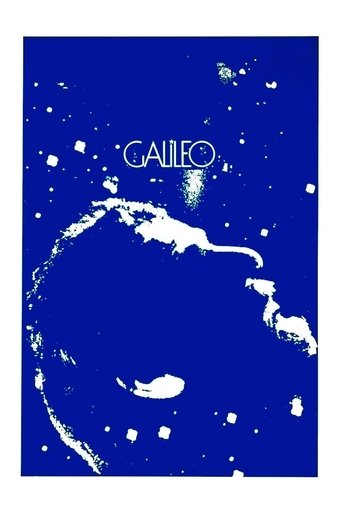
La vida de Galileo (1975)
Galileo
Galileo Galilei, un brillante matemático y astrónomo que nació en Pisa en el siglo XVI, contribuyó de manera decisiva al desarrollo científico. Sus teorías sobre el sistema solar le granjearon el rechazo de las poderosas autoridades eclesiásticas. Basada en una obra de Bertol Brecht, "Galileo" analiza el enfrentamiento de la Iglesia contra un hombre que cuestionó abiertamente el principio de autoridad sobre el que se había basado durante siglos el conocimiento humano.
- Fecha de estreno
- 1975-01-27
- TMDB
- 6.1 / 10 (16)
- Duración
- 2 h 18 min
- Géneros
- Drama, Historia
- Director
- Joseph Losey
Reparto
- Chaim Topol — Galileo Galilei
- Edward Fox — Cardinal Inquisitor
- Colin Blakely — Priuli
- Georgia Brown — Ballad Singer's Wife
- Clive Revill — Ballad Singer
- Margaret Leighton — Elderly Court Lady
- John Gielgud — The Old Cardinal
- Michael Gough — Sagredo
- Michael Lonsdale — Cardinal Barberini (later Pope Urban VIII)
- Richard O'Callaghan — Fulganzio
- Tim Woodward — Ludovico Marsili
- Judy Parfitt — Angelica Sarti
Curiosidades
Galileo is a 1975 historical biographical drama film directed and co-written by Joseph Losey, about the 16th- and 17th-century scientist Galileo Galilei, whose astronomical observations with the newly invented telescope led to a profound conflict with the Roman Catholic Church. The film stars an ensemble cast, led by Topol in the titular role, along with Georgia Brown, Edward Fox, John Gielgud, Margaret Leighton, Colin Blakely, Clive Revill, Michael Lonsdale, Patrick Magee and Tom Conti.
Production
Losey had a long relationship with Brecht that commenced in the 1930s and culminated with the 1947 stage performances of Galileo. After these, Losey mainly worked as a film director. Losey was blacklisted in the US in the early 1950s due to his political activities, which effectively ended his career in the US film industry. He emigrated to England, where he was able to re-establish his career.
The screenplay for Galileo was written by Barbara Bray and Losey. Bray had a long career as an editor, translator, and critic. She is also noted as the longtime companion and mistress of Samuel Beckett, who won the Nobel Prize in Literature in 1969. Besides Galileo, she wrote two other screenplays with Losey. Their screenplay for Galileo relies primarily on the "American" version of Brecht's play that was first performed in 1947.
For the film, Losey maintained several theatrical concepts that had been part of the 1947 theatrical production. These included the use of a trio of young boys whose songs preview parts of the plot, and also the staging of Galileo's recantation against a shadow-filled white screen (cyclorama). Losey's opening shot, an overhead view of the film sound stage, also calls attention to the theatricality of the production.
Casting for the AFT films was unusual. As described by Raymond Benson, "The talent (directors, actors, designers, technicians) was asked to work at a reduced rate or at scale. No one refused. It was for a cause they all thought was worthwhile. Lee Marvin, for example, joked that he 'lost $225,000' by starring in The Iceman Cometh (which meant his salary was $25,000—his going rate at the time was $250,000)."
Prior to casting Topol, Losey had lobbied for Rod Steiger to play the title role.
Leer en Wikipedia · Texto de Wikipedia, CC BY-SA 4.0. Datos de Wikidata.
Recomendadas
- Los dos Papas 2019 · ★ 7.5
- Los fantasmas de Goya 2006 · ★ 6.6
- Pablo, el apóstol de Cristo 2018 · ★ 7.6
- Barrabás 1961 · ★ 6.9
- Julio César 1953 · ★ 7.1
- Escarlata y negro 1983 · ★ 7.1
- Múnich en vísperas de una guerra 2021 · ★ 6.9
- Ocho hombres 1988 · ★ 6.8
- Romero 1989 · ★ 6.9
- Richard Jewell 2019 · ★ 7.4
- La vida inmortal de Henrietta Lacks 2017 · ★ 6.3
- Mr. Turner 2014 · ★ 6.6