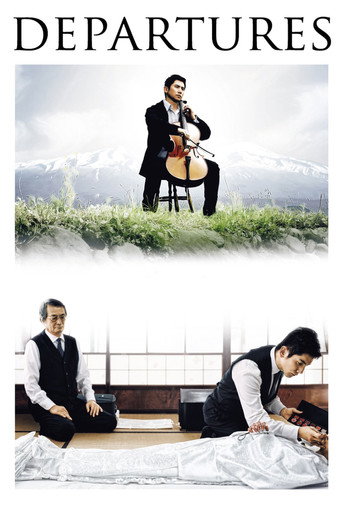
Departures (2008)
おくりびと
The gift of last memories.
Daigo, a cellist, is laid off from his orchestra and moves with his wife back to his small hometown where the living is cheaper. Thinking he’s applying for a job at a travel agency he finds he’s being interviewed for work with departures of a more permanent nature – as an undertaker’s assistant.
- Date of release
- 2008-09-13
- TMDB
- 7.9 / 10 (971)
- Runtime
- 2h 10m
- Genres
- Drama
- Director
- Yojiro Takita
Casting
- Masahiro Motoki — Daigo Kobayashi
- Ryoko Hirosue — Mika Kobayashi
- Tsutomu Yamazaki — Ikuei Sasaki
- Kimiko Yo — Yuriko Kamimura
- Tetta Sugimoto — Yamashita
- Toru Minegishi — Yoshiki Kobayashi
- Tatsuo Yamada — Togashi
- Yukiko Tachibana
- Yukari Tachibana — Rie Yamashita
- Genjitsu Shu
- Taro Ishida — Sonezaki
- Yukimi Koyanagi
Interesting facts
- Filmed in: Japan
- Awards: 7 · Nominations: 8. Including: Asian Film Award for Best Actor; Japan Academy Prize for Director of the Year; Japan Academy Prize for Outstanding Performance by an Actor in a Leading Role; Japan Academy Prize for Screenplay of the Year
Departures is a 2008 Japanese drama film directed by Yōjirō Takita and starring Masahiro Motoki, Ryōko Hirosue, and Tsutomu Yamazaki. The film follows a young man who returns to his hometown after a failed career as a cellist and stumbles across work as a nōkanshi—a traditional Japanese ritual mortician. He is subjected to prejudice from those around him, including from his wife, because of strong social taboos against people who deal with death. Eventually he repairs these interpersonal connections through the beauty and dignity of his work.
Production
Japanese funerals are highly ritualized affairs which are generally—though not always—conducted in accordance with Buddhist rites. In preparation for the funeral, the body is washed and the orifices are blocked with cotton or gauze. The encoffining ritual (called nōkan), as depicted in Departures, is rarely performed, and even then only in rural areas.
Despite the importance of death rituals, in traditional Japanese culture the subject is considered unclean as everything related to death is thought to be a source of kegare (defilement). After coming into contact with the dead, individuals must cleanse themselves through purifying rituals.
Until 1972, most deaths were dealt with by families, funeral homes, or nōkanshi. As of 2014, about 80% of deaths occur in hospitals, and preparation of the bodies is frequently done by hospital staff; in such cases, the family often does not see the body until the funeral. A 1998 survey found that 29.5% of the Japanese population believed in an afterlife, and a further 40% wanted to believe; belief was highest among the young.
In the early 1990s, a 27-year-old Motoki and his friend travelled to India; just before going, at the friend's recommendation he read Shin'ya Fujiwara's Memento Mori (Latin for "remember that you will die"). While in India, he visited Varanasi, where he saw a ceremony in which the dead were cremated and their ashes floated down the Ganges.
Getting funding for the project was difficult because of the taboos against death, and the crew had to approach several companies before Departures was approved by Yasuhiro Mase and Toshiaki Nakazawa. According to the film's director, Yōjirō Takita, a consideration in taking on the film was the age of the crew: "we got to a certain point in our lives when death was creeping up to become a factor around us".
Read on Wikipedia · Text from Wikipedia, CC BY-SA 4.0. Data from Wikidata.
Recommended
- The Castle of Sand 1974 · ★ 7.3
- Blue Giant 2023 · ★ 7.8
- If I Stay 2014 · ★ 7.3
- The Colors Within 2024 · ★ 6.9
- Remarkably Bright Creatures 2026 · ★ 8.4
- Mr. K 2025 · ★ 6.3
- The Caveman's Valentine 2001 · ★ 5.9
- Gigi & Nate 2022 · ★ 7.7
- BECK 2010 · ★ 6.4
- Coda 2020 · ★ 6.1
- Hamlet 1990 · ★ 6.6
- Sound! Euphonium the Movie - Our Promise: A Brand New Day 2019 · ★ 7.1