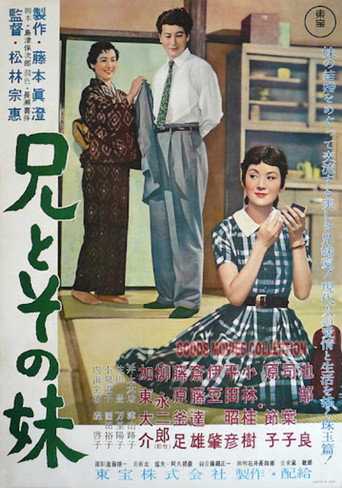
兄とその妹 (1956)
In a household of three the husband is a salaryman who lives with his younger sister and wife in Tokyo. He is returning home late in the evenings because he plays go, or a Japanese version of chess, with his boss. The wife and sister are unhappy about this. The man's co-worker advises him to stop the late evenings out with the boss, but the man cares less. His sister works at a foreign firm and speaks English. When a man who had earlier visited her workplace returns and asks her out for dinner, she rejects him by lying about a husband. He had made impolite comments about her in English during his earlier visit not realizing she understands him.
Distribuție
- 池部良 — Kaisuke Mamiya
- 原節子 — Akiko Mamiya
- 司葉子 — Fumiko Mamiya
- 小林桂樹 — Utsumi
- 平田昭彦 — Michio
- 伊豆肇 — Ikuta
- 藤原釜足 — Shimura
- 加東大介 — Hayashi
- 内海突破 — Sawada
- 岡豊 — Employee B
- 井上大助 — Kawai
- 安芸津広 — Hayashi's Co-worker
Curiozități
Ani to sono musume , also known as Brother and Sister, is a 1956 black-and-white Japanese film drama directed by Shūe Matsubayashi.
Citește pe Wikipedia · Text din Wikipedia, CC BY-SA 4.0. Date din Wikidata.
Recomandate
- Cuibul 2020 · ★ 6.1
- The Kindness of Strangers 2019 · ★ 6.4
- Brotherly Love 2015 · ★ 7.0
- The Young One 1960 · ★ 7.0
- Repast 1951 · ★ 7.6
- The Eel 1997 · ★ 6.9
- The Ballad of Narayama 1983 · ★ 7.5
- Tokyo Sonata 2008 · ★ 7.4
- F.I.S.T. 1978 · ★ 6.5
- Călătorie către regăsire 2019 · ★ 6.1
- Fete rapide 2012 · ★ 6.0
- Gracie 2007 · ★ 6.2