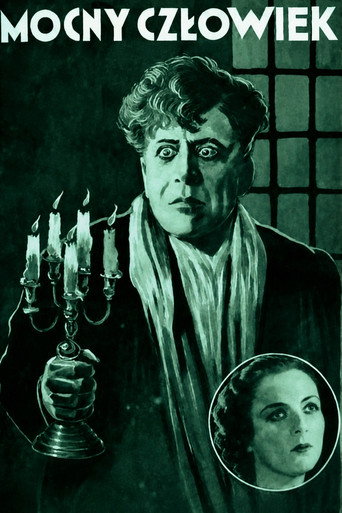
Mocny człowiek (1929)
Bielecki becomes determined to become a famous writer, but the means he employs in achieving his goal are far from ethical. Bielecki discourages his friend Jerzy Gorski by telling him his new work is rather poor, driving him into despair. But Bielecki is such a good friend that he even provides Gorski with the morphine so he can overdose too. With Gorski out of the way, Bielecki can now peddle his friend's book as his own. However, it doesn't take long for Bielecki's evil ways to catch up to him.
- Data de estreia
- 1929-10-02
- TMDB
- 7.3 / 10 (16)
- Duração
- 1 h 17 min
- Géneros
- Crime, Drama, Thriller, Terror
- Realizador
- Henryk Szaro
Elenco
- Gregori Chmara — Henryk Bielecki (as Grzegorz Chmara)
- Agnes Kuck — Lucja
- Julian Krzewiński — Ligeza
- Julian Krzewiński — Nina
- Julian Krzewiński — Writer Jerzy Górski
- Stanisława Wysocka — Bielecki's Grandmother
- Bolesław Mierzejewski — Theatre Manager
- Janina Romanówna — Nastka Zegota
- Aleksander Zelwerowicz — Editor
- Jan Kurnakowicz — Editor's Secretary
- Ludwik Fritsche
- Jerzy Dworski — Karewicz
Curiosidades
A Strong Man is a 1929 Polish psychological thriller directed by Henryk Szaro and produced by Marek Libkow. It is the second adaptation of Stanisław Przybyszewski's 1912 novel of the same name. As one of the last Polish silent films, it presents a study of an artist who ultimately loses a battle with his own conscience.
Production
The screenplay for A Strong Man was based on the three-volume novel by Stanisław Przybyszewski (1911–1913), with each volume titled: Mocny człowiek (A Strong Man), Wyzwolenie (Liberation), and Święty gaj (Sacred Grove). Przybyszewski's literary fame was short-lived, waning during World War I. Thus, the choice to adapt A Strong Man for the screen was unexpected.
The idea for the adaptation came from producer Marek Libkow. The film's director, Henryk Szaro, co-wrote the screenplay with Jerzy Braun, a writer, editor, and publisher of Kraków's Gazeta Literacka. The literary adaptation of the screenplay was overseen by Andrzej Strug, who admitted in interviews that he updated the story's message: "The goal was to throw the protagonist into a contemporary setting, modernize his psyche, and strip away his demo…
The cinematography for A Strong Man was handled by Italian operator Giovanni Vitrotti. The filmmakers shot urban scenes in Warsaw and edited the film using double or, at times, triple exposure. Artur Piskorz, in a retrospective article, described the film's visual aspect (a result of the mentioned editing) as a manifestation of the creators' fascination with urban life: "The even flicker of neon lights, the steady ticking of clocks, the clatter o…
Robert Birkholc noted that "the state of consciousness of the main character is conveyed through a full range of techniques: point-of-view shots, expressive montage contrasts, superimposed images, angles, and camera movements". Szaro drew inspiration from Vsevolod Meyerhold, the creator of the Russian adaptation of A Strong Man, in terms of craftsmanship.
Ler na Wikipédia · Texto da Wikipédia, CC BY-SA 4.0. Dados do Wikidata.
Recomendados
- O Menino que Matou Meus Pais 2021 · ★ 6.3
- A Menina que Matou os Pais: A Confissão 2023 · ★ 6.7
- The House That Jack Built - A Casa de Jack 2018 · ★ 7.1
- À Queima Roupa 1967 · ★ 7.1
- Não Há Crimes Perfeitos 2009 · ★ 6.0
- Maniac 1963 · ★ 6.2
- Barreira do Medo 1962 · ★ 7.4
- Noite Sem Fim 1970 · ★ 5.9
- A Final 2010 · ★ 6.0
- Paixão Sem Limites 1993 · ★ 6.7
- The Perfect Weapon 1991 · ★ 6.4
- A Grande Ilusão 2013 · ★ 6.0