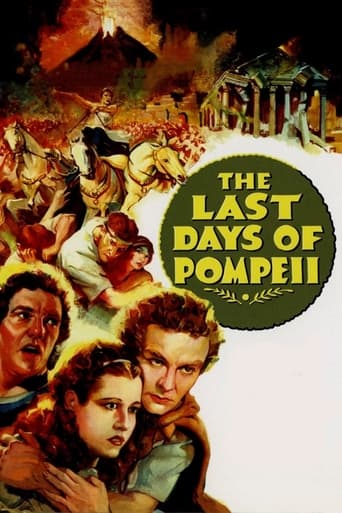
The Last Days of Pompeii (1935)
In this action-filled spectacle set in ancient Pompeii, a blacksmith becomes a Roman gladiator, though his rise to wealth and power is jeopardized by his son's Christianity and the eruption of Vesuvius.
- Data de estreia
- 1935-10-18
- TMDB
- 5.9 / 10 (27)
- Duração
- 1 h 36 min
- Géneros
- Drama, Aventura
- Realizador
- Ernest B. Schoedsack
Elenco
- Preston Foster — Marcus
- Alan Hale — Burbix
- Basil Rathbone — Pontius Pilate
- John Wood — Adult Flavius
- Louis Calhern — Prefect Allus Martius
- David Holt — Flavius as a Boy
- Dorothy Wilson — Clodia
- Wyrley Birch — Leaster
- Frank Conroy — Gaius Tanno (uncredited)
- William V. Mong — Cleon the Slave Dealer (uncredited)
- Murray Kinnell — Simon (uncredited)
- Henry Kolker — Warder (uncredited)
Curiosidades
The Last Days of Pompeii (1935) is an RKO Radio Pictures historical film starring Preston Foster and directed by Merian C. Cooper and Ernest B. Schoedsack, creators of the original King Kong.
Production
While honeymooning in Europe, Cooper visited Pompeii's ruins and felt inspired to produce a movie depicting the volcanic eruption that devastated the city. The Last Days of Pompeii, along with She, were part of a two-picture agreement with Cooper, with the initial agreement stating that each film would be made for $1 million each.
Although inspired by the novel of the same name by Edward Bulwer-Lytton, the film has nothing to do with the book. The film's plot compresses the time between Christ's death and Vesuvius's eruption into 10–20 years. Ruth Rose wrote the screenplay, which drew elements from a story by James Creelman and Melville Baker. The story was meant to imitate DeMille's religious epics, like The Sign of the Cross in scope and grandiosity.
Willis O'Brien supervised the special effects for the climactic eruption scene. According to an article published in the Manila-based Tribune, large sets were constructed for the film, including a reproduction of the Temple of Jupiter with part of the Pompeiian forum, as well as the Pompeiian arena. The house of a wealthy Roman was reconstructed for the film. Many of these sets were destroyed on-camera as part of the final eruption scenes.
Historical accuracy was not a priority for the production. The recently established film production code required that the inclusion of violence include moral messaging, which may explain the film's Christian message. Last Days includes a final repentance by Marcus that seems designed to align with a rule that wrongdoers in movies reform if they have a happy ending.
Ler na Wikipédia · Texto da Wikipédia, CC BY-SA 4.0. Dados do Wikidata.
Recomendados
- Jacob 1994 · ★ 6.7
- Voo Noturno para LA: Uma História para Todas as Idades 2026 · ★ 6.3
- O Rei dos Reis 2025 · ★ 8.3
- Esther 1999 · ★ 6.8
- As Grandes Aventuras do Capitão Grant 1962 · ★ 6.5
- David 1997 · ★ 6.7
- Jesus 1999 · ★ 6.8
- Vontade de Ferro 1994 · ★ 6.7
- O Jovem Prodígio T.S. Spivet 2013 · ★ 6.9
- Abraham 1993 · ★ 7.2
- Gold Diggers: The Secret of Bear Mountain 1995 · ★ 6.2
- Anastásia 1997 · ★ 7.6