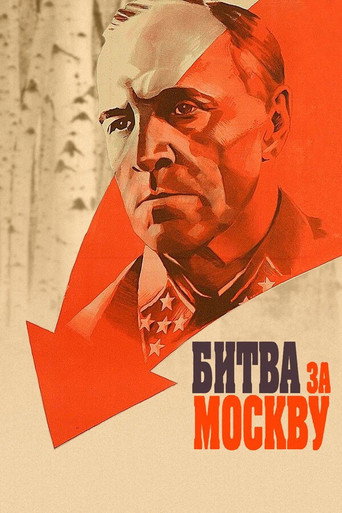
La Batalla de Moscú (1985)
Битва за Москву
La batalla de Moscú narra la heroica lucha del pueblo soviético ante las complejas situaciones que se crearon inmediatamente antes y después del ataque por parte de la Alemania nazi a la Unión de Repúblicas Socialistas Soviéticas.
- Fecha de estreno
- 1985-11-05
- Géneros
- Bélica, Historia, Drama
- Director
- Юрий Озеров
Reparto
- Яков Трипольский — Yosif Stalin
- Михаил Ульянов — Georgiy Zhukov
- Александр Голобородько — Konstantin Rokossovskiy
- Віталій Розстальний — Semyon Timoshenko
- Бруно Фрейндлих — Boris Shaposhnikov
- Юрий Яковлев — Leonid Petrovskiy
- Juozas Budraitis — Richard Sorge
- Валерий Юрченко — Nikolay Popel
- Romualds Ancāns — Pyotr Gavrilov
- Эммануил Виторган — Efim Fomin
- Ирина Шмелёва — Zoya Kosmodemyanskaya
- Костянтин Степанков — Ivan Panfilov
Curiosidades
The Battle of Moscow is a 1985 Soviet two-part war film, presenting a dramatized account of the Battle of Moscow during the Second World War, and the events preceding it. The two-part film was a Soviet–East German–Czechoslovak–Vietnamese co-production, directed and written by Yuri Ozerov. It was made in time for the 40th anniversary of the Allied victory over Nazi Germany and the 20th anniversary of the proclamation of the Victory Day holiday and Moscow's declaration as a Hero City.
Production
Battle of Moscow was director Ozerov's third film dealing with the Second World War, after the five-part Liberation (1970) and the TV mini-series Soldiers of Freedom (1977). Ozerov was not allowed to deal with the early, dark chapters of the war in Liberation due to political pressure, and Soldiers of Freedom revolved around the battles outside the Soviet Union.
Unlike Liberation, Ozerov's most acclaimed work, Battle of Moscow was a purely historical film, with no fictional characters included in the plot. The actors selected to portray the main roles were mostly ones who already appeared as such in the director's earlier works, especially Mikhail Ulyanov who depicted Zhukov in all of Ozerov's films. Eventually, the production involved a crew of some six thousand people.
The German-speaking actors were contacted through DEFA, while the scenes involving Richard Sorge were shot in Vietnam with the assistance of the Fafim studio. Marshal Sergei Rudenko served as the chief military consultant of the movie; the battle scenes involved troops from the Red Army as extras.
The film premiered in the Moscow Film Festival.
Leer en Wikipedia · Texto de Wikipedia, CC BY-SA 4.0. Datos de Wikidata.
Recomendadas
- Letchik 2021 · ★ 6.5
- AK-47 2020 · ★ 7.6
- El último soldado 2023 · ★ 6.6
- Waiting for Anya 2020 · ★ 6.3
- KV1: Almas de hierro 2018 · ★ 6.6
- La novena compañía 2005 · ★ 6.6
- Al lado del enemigo 2014 · ★ 6.3
- Liberacion La direccion del ataque Principal (Osvobozhdenie Part 3) 1971 · ★ 6.0
- Lucharon por su patria 1975 · ★ 6.9
- Beneath Hill 60 2010 · ★ 6.8
- Cristiada 2012 · ★ 7.0
- Monuments Men 2014 · ★ 6.1