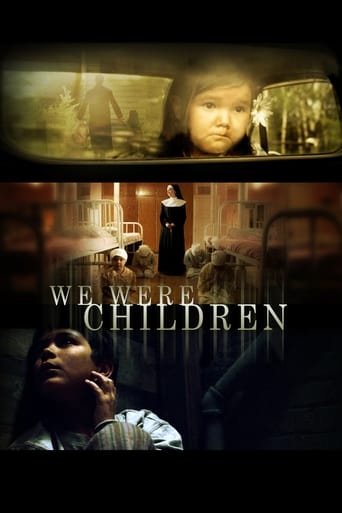
We Were Children (2012)
For over 130 years till 1996, more than 100,000 of Canada's First Nations children were legally required to attend government-funded schools run by various Christian faiths. There were 80 of these 'residential schools' across the country. Most children were sent to faraway schools that separated them from their families and traditional land. These children endured brutality, physical hardship, mental degradation, and the complete erasure of their culture. The schools were part of a wider program of assimilation designed to integrate the native population into 'Canadian society.' These schools were established with the express purpose 'To kill the Indian in the child.' Told through their own voices, 'We Were Children' is the shocking true story of two such children: Glen Anaquod and Lyna Hart.
- Erscheinungsdatum
- 2012-03-03
- TMDB
- 7.2 / 10 (11)
- Laufzeit
- 1 Std. 28 Min.
- Genres
- Dokumentarfilm
- Regie
- Tim Wolochatiuk
Besetzung
- Lyna Hart — Self
- Ross McMillan — Father Y
- Glen Anaquod — Self
- Alicia Hamelin — Lyna (4 Yrs Old)
- Jade Hamelin — Lyna (10 Yrs Old)
- Jennie Morin — Lyna (18 Yrs Old)
- Rebecca Gibson — Sister Mary
- Rene Batson — Glen (6-7 Yrs Old)
- Brun Montour — Glen (12 Yrs Old)
- Justin Ducharme — Glen (18 Yrs Old)
- Justin Courchene — Glen (Adult)
- Tyrone Brooks — Glen's Cousin (6-7 Yrs Old)
Wissenswertes
We Were Children is a 2012 Canadian documentary film about the experiences of First Nations children in the Canadian Indian residential school system. Directed by Tim Wolochatiuk and written by Jason Sherman, the film recounts the experiences of two residential school survivors: Lyna Hart, who attended the Guy Hill Residential School in Manitoba, and Glen Anaquod, who attended the Lebret Indian Residential School in Saskatchewan. We Were Children presents their experiences through a combination of personal interviews and dramatic recreations.
Production
Eagle Vision's executive producer Lisa Meeches—whose parents and older siblings were sent to residential schools, and who spent over 7 years travelling across Canada to collect residential school survivors' stories for the Government of Canada—has stated that the idea for the film originated from a discussion she had had at the Banff World Media Festival. It was Meeches who approached director Tim Wolochatiuk with the project.
The film was shot in Manitoba, namely in Winnipeg, St-Pierre-Jolys, and at the former Portage residential school (now the Rufus Prince building) in Portage la Prairie. It was produced by Kyle Irving for Eagle Vision, Loren Mawhinney for eOne Television, and produced and executive produced by David Christensen for the National Film Board of Canada.
CBC Manitoba reporter Sheila North Wilson assisted the production by translating material in the script from English to Cree.
Auf Wikipedia weiterlesen · Text aus Wikipedia, CC BY-SA 4.0. Daten aus Wikidata.
Empfohlen
- Stories We Tell 2012 · ★ 7.1
- Sidney 2022 · ★ 6.9
- Avatar: The Deep Dive - A Special Edition of 20/20 2022 · ★ 7.2
- Die Akte USA gegen John Lennon 2006 · ★ 6.6
- The Class of ‘92 2013 · ★ 7.1
- HyperNormalisation 2016 · ★ 7.5
- South of the Border 2009 · ★ 6.1
- The War Room 1993 · ★ 6.8
- GEMEINSAM UNBESIEGBAR: Das Making of Hawkeye 2022 · ★ 7.2
- Verführt und Verlassen 2013 · ★ 6.2
- Misha und die Wölfe 2021 · ★ 6.9
- Heart of a Dog 2015 · ★ 6.5