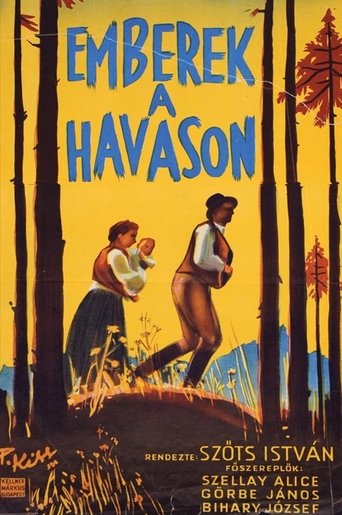
Emberek a havason (1942)
A simple, religious Hungarian woodcutter lives with his wife and boy child with a small community of squatters among the peaceful mountains of Transylvania until a lumber company claims their land and forces them all to become company workers or else leave the land. This 1942 Hungarian film takes a detailed and unflinching look at the hardships of mountain living, and the realistic approach proved influential to the Neorealist movement in Italian cinema. Hungarian master director Istvan Szots won the Biennale Cup at the Venice Film Festival for his auspicious debut, but the film was banned by the Nazis as "too Catholic" and not publicly exhibited until after World War II.
- Data de estreia
- 1942-02-28
- TMDB
- 7.6 / 10 (13)
- Duração
- 1 h 28 min
- Géneros
- Drama
- Realizador
- István Szőts
Elenco
- János Görbe — Gergely Csutak
- Alice Szellay — Anna Csutak
- Péterke Ferency — Gergö Csutak, their son
- József Bihari — Márton Üdö , Gergo's godfather
- Lajos Gárday — Ádám Ülkei
- Oszkár Borovszky — manager
- Lenke Egyed — maid
- Imre Toronyi — György Bende, doctor
- György Kürthy — György Bende
- Elemér Baló — woodcutter
- János Pásztor — woodcutter
- Jenö Danis — woodcutter
Curiosidades
People of the Mountains is a 1942 Hungarian drama film directed by István Szőts and starring Alice Szellay, János Görbe, Péterke Ferency. The film is set in the Székely woodcutting community of Transylvania. The film's plot was based on a series of short stories by József Nyírő. The film was exhibited at the 1942 Venice Film Festival, where it was widely praised. The film's style has been suggested as an influence on the emerging Italian neorealism. It was not granted an exhibition certificate in Nazi Germany because Joseph Goebbels considered it "too Catholic". The film was chosen to be part of the New Budapest Twelve, a list of Hungarian films considered the best in 2000.
Production
The film was shot on location in Northern Transylvania, which had been ceded back to the Kingdom of Hungary by the Kingdom of Romania according to the Second Vienna Award in 1940, before Hungary and Romania entered the Second World War. Interior scenes were filmed at the Hunnia Film Studio in Budapest. The film was originally conceived as a short film, but the studios' bosses agreed to make it a feature film as long as costs could be kept low.
Ler na Wikipédia · Texto da Wikipédia, CC BY-SA 4.0. Dados do Wikidata.
Recomendados
- O Tango de Satanás 1994 · ★ 8.0
- O Filme da Minha Vida 2017 · ★ 7.3
- O Céu de Suely 2006 · ★ 7.3
- Home Run 2013 · ★ 6.2
- Three Christs 2017 · ★ 6.7
- Farming 2018 · ★ 6.2
- Marcas da Guerra 2005 · ★ 6.9
- A Visita 1964 · ★ 7.2
- El Chicano 2019 · ★ 6.6
- Hardball - O Jogo da Vida 2001 · ★ 6.5
- A Jovem 1960 · ★ 7.0
- I Am Elizabeth Smart 2017 · ★ 6.8