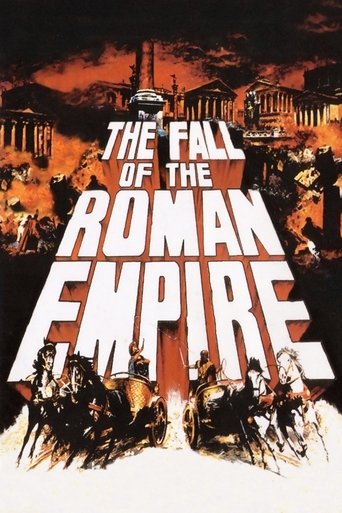
The Fall of the Roman Empire (1964)
Never before a spectacle like the fall of the Roman empire
In the year 180 A.D. Germanic tribes are about to invade the Roman empire from the north. In the midst of this crisis ailing emperor Marcus Aurelius has to make a decision about his successor between his son Commodus, who is obsessed by power, and the loyal general Gaius Livius.
- Date of release
- 1964-03-24
- TMDB
- 6.4 / 10 (246)
- Runtime
- 3h 8m
- Genres
- Drama, History, War
- Director
- Anthony Mann
Casting
- Sophia Loren — Lucilla
- Stephen Boyd — Livius
- Alec Guinness — Marcus Aurelius
- James Mason — Timonides
- Christopher Plummer — Commodus
- Anthony Quayle — Verulus
- John Ireland — Ballomar
- Omar Sharif — Sohamus
- Mel Ferrer — Cleander
- Eric Porter — Julianus
- Finlay Currie — Senator
- Andrew Keir — Polybius
Interesting facts
- Box office: $4.8M
- Budget: $19M
- Earned 0.3× its budget
- Filmed in: Madrid and Spain
- Awards: 0 · Nominations: 1
The Fall of the Roman Empire is a 1964 American epic historical drama film directed by Anthony Mann and produced by Samuel Bronston, with a screenplay by Ben Barzman, Basilio Franchina and Philip Yordan. The film stars Sophia Loren, Stephen Boyd, Alec Guinness, James Mason, Christopher Plummer, Mel Ferrer and Omar Sharif.
Production
The idea for The Fall of the Roman Empire originated with Anthony Mann who had just finished directing El Cid (1961). In London, while waiting for a taxi cab, he spotted an Oxford concise edition of Edward Gibbon's six-volume series The History of the Decline and Fall of the Roman Empire near the front window at the Hatchards bookshop.
In September 1961, Bronston formally announced he was planning a trilogy of historical spectacles in Spain, which included The Fall of the Roman Empire with Mann and Heston returning to direct and star in. Filming was initially set in February 1962, with the production design for the recreated Roman Forum supervised by Veniero Colasanti and John Moore. Months later, by December 1961, Heston had disliked Yordan's script for the film.
In April 1963, Mann explained to the Los Angeles Times that while the film was not a direct adaptation of Gibbon's volume series, the focus on a fifteen-year period from Marcus Aurelius's reign to Commodus's death was backed by historians as "the turning point in the history of the empire and by concentrating our story on it we can keep the same group of characters within the range of our drama." Having selected a focal point for the film, screen…
After this, Mann consulted with the screenwriters on further developing the characters, in which they wrote six drafts in total. The sixth draft was developed during filming. Mann later explained, "The writing took us more than one year. We did not have artists in mind when we were writing; but we wanted characters with memorable scenes to attract artists of the calibre of Guinness to want to play them."
As the script was being written, the Roman Forum was constructed on Bronston's studio backlot although their script had made no mention of it. Under Yordan's supervision, the action was re-written for scenes they had not written for the Forum to occur there, which brought much dismay from Barzman. In January 1963, it was reported that historian Will Durant had written a prologue for the film.
Read on Wikipedia · Text from Wikipedia, CC BY-SA 4.0. Data from Wikidata.
Recommended
- Julius Caesar 1970 · ★ 5.9
- Barabbas 1961 · ★ 6.9
- Zulu Dawn 1979 · ★ 6.1
- The Scarlet and the Black 1983 · ★ 7.1
- Demetrius and the Gladiators 1954 · ★ 6.6
- The Last Rifleman 2023 · ★ 6.6
- Zulu 1964 · ★ 7.4
- Cast a Giant Shadow 1966 · ★ 6.3
- Lion of the Desert 1981 · ★ 7.3
- Agora 2009 · ★ 7.0
- Waiting for Anya 2020 · ★ 6.3
- The Court-Martial of Billy Mitchell 1955 · ★ 6.8