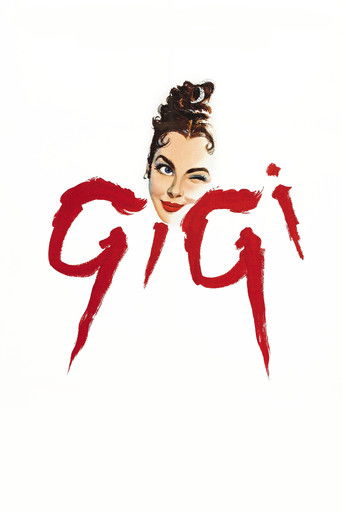
Gigi (1958)
Thank heaven for Gigi
A home, a motorcar, servants, the latest fashions: the most eligible and most finicky bachelor in Paris offers them all to Gigi. But she, who's gone from girlish gawkishness to cultured glamour before our eyes, yearns for that wonderful something money can't buy.
- Date of release
- 1958-05-15
- TMDB
- 6.2 / 10 (365)
- Runtime
- 1h 55m
- Genres
- Comedy, Romance
- Director
- Vincente Minnelli
Casting
- Leslie Caron — Gigi
- Maurice Chevalier — Honoré Lachaille
- Louis Jourdan — Gaston Lachaille
- Hermione Gingold — Madame Alvarez
- Eva Gabor — Liane D'Exelmans
- Jacques Bergerac — Sandomir
- Isabel Jeans — Aunt Alicia
- John Abbott — Manuel
- Corinne Marchand — Young Lady with White Sunshade (uncredited)
- Marie-Hélène Arnaud — Girl at Maxim's (uncredited)
- Anne-Marie Mersen — Maxim Girl (uncredited)
- Jack Ary — Waiter at Palais De Glace (uncredited)
Interesting facts
- Box office: $13.2M
- Budget: $3.3M
- Earned 4× its budget
- Based on: Gigi
- Awards: 9 · Nominations: 8. Including: Academy Award for Best Picture; Academy Award for Best Director; Academy Award for Best Cinematography, Color; Academy Award for Best Film Editing
Gigi is a 1958 American musical romantic comedy film directed by Vincente Minnelli and processed using Metro-Goldwyn-Mayer's Eastmancolor film process Metrocolor. The screenplay by Alan Jay Lerner is based on the 1944 novella by Colette. The film features songs with lyrics by Lerner and music by Frederick Loewe, arranged and conducted by André Previn. Costume design was done by Cecil Beaton.
Production
Hollywood producer Arthur Freed first proposed a musicalization of the Colette novella to Alan Jay Lerner during the Philadelphia tryout of My Fair Lady in 1956. When Lerner arrived in Hollywood two years later, Freed was battling the Hays Code to bring his tale of a courtesan-in-training to the screen.
Lerner's songwriting partner Frederick Loewe had expressed no interest in working in Hollywood, so Lerner agreed to write the screenplay only. He and Freed discussed casting; Lerner favored Audrey Hepburn, who had starred in the Broadway production written by Loos, but Freed preferred
MGM contract star Leslie Caron, who had co-starred in An American in Paris for him. Both agreed Maurice Chevalier would be ideal for aging boulevardier Honoré Lachaille, and Lerner proposed Dirk Bogarde for Gaston. Lerner agreed to write the lyrics if Freed could convince Bogarde and designer Cecil Beaton to join the project. He decided to approach Loewe once again, and when he suggested they compose the score in Paris, Loewe agreed.
In March 1957, the duo began working in Paris. When Chevalier, who already had agreed to appear in the film, first heard "Thank Heaven for Little Girls", he was delighted. When he discussed his waning interest in wine and women in favor of performing for an audience in cabarets, Chevalier inadvertently inspired the creation of another tune for his character, "I'm Glad I'm Not Young Anymore".
Lerner recalls that for the film Gigi, "The casting was so haphazard, I don't know how they ever got it on." He wrote the part of Honoré Lachaille for Chevalier, but the rest of the casting was still undecided. Having second thoughts about Audrey Hepburn, Freed asked Lerner to meet with her in Paris, but she declined the role. The producer then asked him to fly to London to speak to Leslie Caron, who was living there with her husband Peter Hall.
Read on Wikipedia · Text from Wikipedia, CC BY-SA 4.0. Data from Wikidata.
Recommended
- Roberta 1935 · ★ 7.1
- Midnight in Paris 2011 · ★ 7.5
- Sabrina 1995 · ★ 6.2
- The Wrong Paris 2025 · ★ 6.7
- Daddy Long Legs 1955 · ★ 6.4
- Funny Face 1957 · ★ 7.0
- Gentlemen Prefer Blondes 1953 · ★ 7.3
- Ninotchka 1939 · ★ 7.5
- Beauty and the Beast 1991 · ★ 7.7
- What's Love Got to Do with It? 2023 · ★ 6.1
- A Little Romance 1979 · ★ 6.8
- An American in Paris 1951 · ★ 7.0