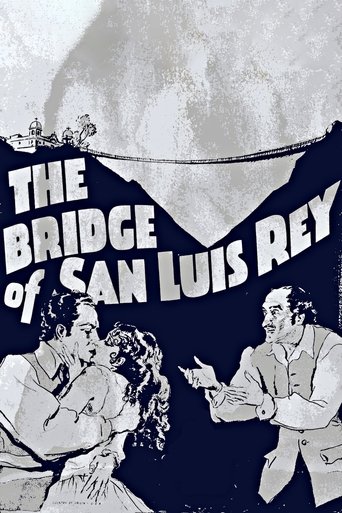
The Bridge of San Luis Rey (1929)
This first cinematic version of the classic book is a part-talkie, although the only surviving print is silent (housed in the George Eastman House, Rochester, NY). It is a straight-forward telling of the intermingled lives of a group of strangers doomed to die in a collapsing bridge accident. The Art Direction, paltry and unremarkable, surprisingly won an Oscar over the far more remarkable work nominated in THE IRON MASK. The special effect scene of the lovers plummeting with the bridge into the chasm is unforgettable and remarkably done.
- Date of release
- 1929-03-30
- TMDB
- 8.0 / 10 (4)
- Runtime
- 1h 27m
- Genres
- Drama
- Director
- Charles Brabin
Casting
- Lili Damita — Camila (La Perichole)
- Ernest Torrence — Uncle Pio
- Raquel Torres — Pepita
- Don Alvarado — Manuel
- Duncan Renaldo — Esteban
- Henry B. Walthall — Father Juniper
- Michael Vavitch — Viceroy
- Emily Fitzroy — Marquesa
- Jane Winton — Doña Carla
Interesting facts
- Based on: The Bridge of San Luis Rey
- Awards: 1 · Nominations: 1. Including: Academy Award for Best Production Design
The Bridge of San Luis Rey is a 1929 American sound part-talkie film released by Metro-Goldwyn-Mayer. The film was directed by Charles Brabin and starred Lili Damita and Don Alvarado. In addition to sequences with audible dialogue or talking sequences, the film features a synchronized musical score and sound effects along with English intertitles. The sound was recorded via the Western Electric sound-on-film process.
Background and production
The film and novel are very loosely based on the real-life story of Micaela Villegas (1748–1819), a famous Peruvian entertainer known as La Perichole. Her life was also the inspiration for the novella Le Carrosse du Saint-Sacrement by Prosper Mérimée; the opéra bouffe La Périchole by Jacques Offenbach; and Jean Renoir’s 1953 film Le Carrosse d'or (The Golden Coach).
Read on Wikipedia · Text from Wikipedia, CC BY-SA 4.0. Data from Wikidata.
Recommended
- Won't Back Down 2012 · ★ 6.2
- Mindwalk 1991 · ★ 6.9
- Fatima 2020 · ★ 7.2
- The Safety of Objects 2002 · ★ 6.5
- Thirteen Conversations About One Thing 2001 · ★ 6.2
- Doubt 2008 · ★ 7.2
- Mansfield Park 2007 · ★ 6.1
- Wonderstruck 2017 · ★ 6.1
- The Effect of Gamma Rays on Man-in-the-Moon Marigolds 1972 · ★ 7.3
- Mr. Pip 2012 · ★ 6.2
- Come Sunday 2018 · ★ 5.8
- The Bridge on the River Kwai 1957 · ★ 7.8