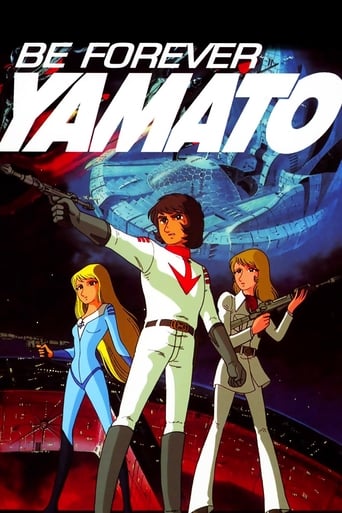
Be Forever Yamato (1980)
ヤマトよ永遠に
The Black Nebula Empire attacks Earth and threatens to blow up the planet with a bomb they placed on Earth if counter attacked. Earths hopes rest on the Yamato crew as they go to the Black Nebula Planet and try to find a way to difuse the bomb before it's too late.
- Date of release
- 1980-08-01
- TMDB
- 7.5 / 10 (11)
- Runtime
- 2h 25m
- Genres
- Animation, Drama, Science Fiction, Action
- Director
- Leiji Matsumoto, Tomoharu Katsumata, Toshio Masuda
- Collection
- Space Battleship Yamato Collection
Casting
- Kei Tomiyama — Susumu Kodai (voice)
- Shūsei Nakamura — Daisuke Shima (voice)
- Takeshi Aono — Shirou Sanada (voice)
- Keiko Han — Sasha Kodai (voice)
- Yoko Asagami — Yuki Mori (voice)
- Shinji Nomura — Yoshikazu Aihara (voice)
- Ichiro Nagai — Sakezou Sado (voice)
- Kenichi Ogata — Analyzer (voice)
- Akira Kamiya — Shiro Kato (voice)
- Taichiro Hirokawa — Mamoru Kodai (voice)
- Miyuki Ueda — Starsha (voice)
- Toru Furuya — Tasuke Tokugawa (voice)
Interesting facts
- Based on: Space Battleship Yamato
Be Forever Yamato is a 1980 Japanese science fiction anime film and the fourth film based on the classic anime series Space Battleship Yamato. The film is unique for switching from monaural VistaVision (1.85:1) to Quadraphonic CinemaScope (2.35:1) when the Yamato enters the Double Galaxy. It later got a remake in 2024 as Be Forever Yamato: Rebel 3199.
Production
This movie was intended to be Space Battleship Yamato III. According to Yoshinobu Nishizaki, the purpose of creating a third Yamato was for the younger generation: "However, there are themes to be expressed and a lot of people hope to see it again, so I think Yamato should make another appearance. It is not only for the people who watched from the beginning, nor is it for my sake.
Nishizaki and Leiji Matsumoto, writer of the previous films, met on October 23, 1979, to discuss their goals and vision for the new film. After this, Matsumoto began developing the ideas into a story synopsis. His 'B' draft was completed on December 31, 1979, and the line 'Be Forever Yamato' appeared at the end of the script. At this point, it was not intended to be the title of the film.
Inspiration for the film was taken from The Black Hole and Star Trek: The Motion Picture. The film was initially meant to be shot in 70mm, but this would be scaled back due to time constraints. However, the film made use of other revolutionary techniques for an anime film. These included scanimation and animating part of the film in the Cinemascope aspect ratio.
Notably, Be Forever Yamato includes a shift from VistaVision size to Cinemascope in one of the scenes, as well as a change to stero sound. Nishizaki's aim with this was to capture the depth of outer space; however, only a few theatres throughout Japan could show it due to technical limitations.
Read on Wikipedia · Text from Wikipedia, CC BY-SA 4.0. Data from Wikidata.
Recommended
- Doraemon: Nobita's Little Star Wars 1985 · ★ 7.2
- Pokémon the Movie: Kyurem vs. the Sword of Justice 2012 · ★ 6.5
- Doraemon: Nobita and the Winged Braves 2001 · ★ 7.1
- Doraemon: Nobita and the Steel Troops 1986 · ★ 6.7
- Justice League: Gods and Monsters 2015 · ★ 7.1
- Pokémon the Movie: Genesect and the Legend Awakened 2013 · ★ 6.4
- Scarlet 2025 · ★ 6.9
- Doraemon: Nobita and the Windmasters 2003 · ★ 7.2
- Stand by Me Doraemon 2014 · ★ 7.5
- BLAME! 2017 · ★ 6.5
- Mobile Suit Gundam Hathaway 2021 · ★ 7.2
- Doraemon: Nobita's Dorabian Nights 1991 · ★ 7.0