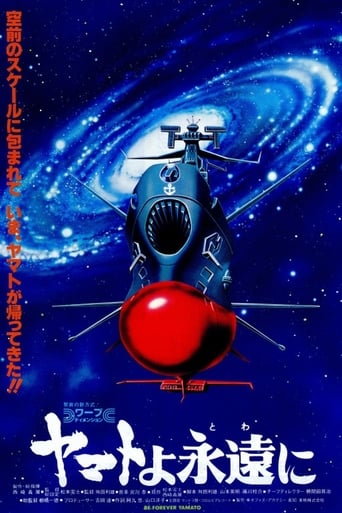
Ямато навсегда (1980)
ヤマトよ永遠に
Космический линкор, названный в честь своего исторического прообраза - затопленного во 2-ю Мировую и найденного спустя столетия на высохшем дне океана лучшего, по мнению многих, военного корабля Японии, отправляется в глубокий космос с целью найти помощь для гибнущей Земли, подвергающейся атакам враждебной цивилизации. На пути отважным космонавтам встречаются всевозможные опасности.
- Дата выхода
- 1980-08-01
- TMDB
- 7.5 / 10 (11)
- Длительность
- 2 ч 25 мин
- Жанры
- мультфильм, драма, фантастика, боевик
- Режиссёр
- 勝間田具治, 松本零士, 舛田利雄
- Коллекция
- Space Battleship Yamato Collection
В ролях
- 富山敬 — Susumu Kodai (voice)
- 仲村秀生 — Daisuke Shima (voice)
- Такэси Аоно — Shirou Sanada (voice)
- Кэйко Хан — Sasha Kodai (voice)
- Йоко Асагами — Yuki Mori (voice)
- 野村信次 — Yoshikazu Aihara (voice)
- Ичиро Нагай — Sakezou Sado (voice)
- Кэнъичи Огата — Analyzer (voice)
- 神谷明 — Shiro Kato (voice)
- 広川太一郎 — Mamoru Kodai (voice)
- 上田みゆき — Starsha (voice)
- 古谷徹 — Tasuke Tokugawa (voice)
Интересные факты
- Основан на: Space Battleship Yamato
Be Forever Yamato is a 1980 Japanese science fiction anime film and the fourth film based on the classic anime series Space Battleship Yamato. The film is unique for switching from monaural VistaVision (1.85:1) to Quadraphonic CinemaScope (2.35:1) when the Yamato enters the Double Galaxy. It later got a remake in 2024 as Be Forever Yamato: Rebel 3199.
Production
This movie was intended to be Space Battleship Yamato III. According to Yoshinobu Nishizaki, the purpose of creating a third Yamato was for the younger generation: "However, there are themes to be expressed and a lot of people hope to see it again, so I think Yamato should make another appearance. It is not only for the people who watched from the beginning, nor is it for my sake.
Nishizaki and Leiji Matsumoto, writer of the previous films, met on October 23, 1979, to discuss their goals and vision for the new film. After this, Matsumoto began developing the ideas into a story synopsis. His 'B' draft was completed on December 31, 1979, and the line 'Be Forever Yamato' appeared at the end of the script. At this point, it was not intended to be the title of the film.
Inspiration for the film was taken from The Black Hole and Star Trek: The Motion Picture. The film was initially meant to be shot in 70mm, but this would be scaled back due to time constraints. However, the film made use of other revolutionary techniques for an anime film. These included scanimation and animating part of the film in the Cinemascope aspect ratio.
Notably, Be Forever Yamato includes a shift from VistaVision size to Cinemascope in one of the scenes, as well as a change to stero sound. Nishizaki's aim with this was to capture the depth of outer space; however, only a few theatres throughout Japan could show it due to technical limitations.
Читать в Википедии · Текст из Википедии, CC BY-SA 4.0. Данные Викиданных.
Рекомендуем
- Pokémon the Movie: Kyurem vs. the Sword of Justice 2012 · ★ 6.5
- Doraemon: Nobita and the Winged Braves 2001 · ★ 7.1
- Doraemon: Nobita and the Steel Troops 1986 · ★ 6.7
- Лига справедливости: Боги и монстры 2015 · ★ 7.1
- Pokémon the Movie: Genesect and the Legend Awakened 2013 · ★ 6.4
- Скарлет 2025 · ★ 6.9
- Дораэмон: Останься со мной 2014 · ★ 7.5
- Doraemon: Nobita and the Windmasters 2003 · ★ 7.2
- Мобильный воин Гандам: вспышка Хэтэуэя 2021 · ★ 7.2
- Doraemon: Nobita's Dorabian Nights 1991 · ★ 7.0
- Блам! 2017 · ★ 6.5
- Покемон: Современное поколение — Лукарио и загадка Мью 2005 · ★ 7.0