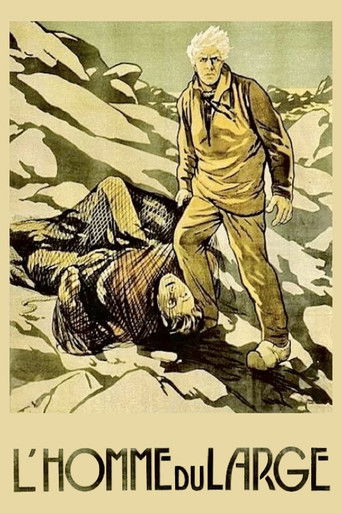
L'Homme du large (1920)
Nolff, a tough Breton fisherman is happy: his wife has just given birth to a son, Michel. His only wish is to make him a fisherman like him. But when he becomes a man, Michel becomes a good-for-nothing who spends his time in taverns.
- Data lansării
- 1920-12-03
- TMDB
- 6.0 / 10 (14)
- Durată
- 1 h 26 min
- Genuri
- Dramă
- Regizor
- Marcel L'Herbier
Distribuție
- Jaque Catelain — Michel
- Roger Karl — Nolff
- Charles Boyer — Guenn la Taupe
- Philippe Hériat — Le protecteur
- Marcelle Pradot — Djenna
- Claire Prélia — La mère de Michel et de Djenna
- Suzanne Doris — Lia
- Claude Autant-Lara — Un des copains (uncredited)
- Dimitri Dragomir — Un des copains (uncredited)
- Lili Samuel — La lesbienne (uncredited)
- Georges Forois — Un pêcheur (uncredited)
- Madame Pâquerette — La tenancière (uncredited)
Curiozități
- Bazat pe: Un drame au bord de la mer
- Filmat în: Penmarch
L' Homme du large is a 1920 French silent film directed by Marcel L'Herbier and based on a short story by Honoré de Balzac. It was filmed on the rugged southern coast of Brittany creating atmosphere in a film about the forces of good and evil that motivate human behaviour.
Production
In June 1920, L'Herbier took a large crew to Brittany for location shooting around the coasts of Morbihan and Finistère, where he sought the wild landscapes which would establish the story's moral contrast between the pure grandeur of the sea and the corrupt temptations of the town. For the first time he had an "assistant director", a young man called Raymond Payelle who would soon take the professional name of Philippe Hériat.
L'Herbier's structure for the narrative was unusual in that it started at the end and then told the story in flashback: he claimed that this was the first time that this device had been used in the cinema. Despite his claim, this frame narrative technique had been utilized by multiple directors in the preceding years, notably by Irvin Willat in Behind the Door.
L'Herbier also took a novel approach to the use of some of his intertitles which, instead of being inserted between shots of the film, were integrated into the image itself so that they formed part of the visual design and did not interrupt the flow of the film.
A detailed programme of tinting for the entire film gave a complex interplay of colour contrasts, both between scenes and in individual sequences: for instance, the scenes in the town bar (the "bouge") are tinted in a lurid red, and intercut with the mauve-tinted scenes showing the feverish mother at home.
Jaque Catelain assisted L'Herbier with the editing of the film.
Citește pe Wikipedia · Text din Wikipedia, CC BY-SA 4.0. Date din Wikidata.
Recomandate
- Father of My Children 2009 · ★ 6.7
- The Last Woman 1976 · ★ 6.1
- Fratele meu 2019 · ★ 6.5
- Return 2011 · ★ 6.4
- Stillwater 2021 · ★ 6.6
- Angel Face 2018 · ★ 6.2
- Come Sunday 2018 · ★ 5.8
- At Work 2026 · ★ 6.5
- Siguranța obiectelor 2002 · ★ 6.5
- Mindwalk 1991 · ★ 6.9
- Agentul înșelător 2022 · ★ 6.3
- Pumni de piatră 2016 · ★ 6.6