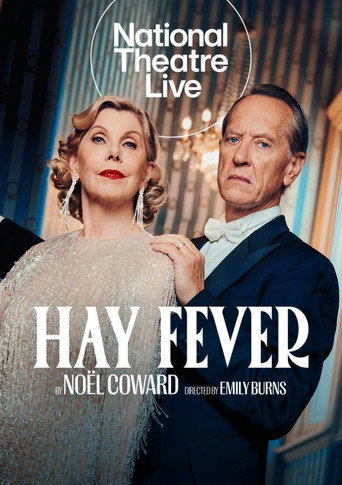
National Theatre Live: Hay Fever (2027)
It's loathsome being looked after. Last year, Judith retired from her life-on-stage. Already, she misses the applause. Idling away at their country home, the rest of the family—reclusive novelist husband David and failure-to-launch children Sorrel and Simon—are too self-involved to be a good audience. So, Judith invites a young fan as her guest for the weekend. But unbeknownst to her, each of the Blisses have a guest of their own arriving at the very same time. Completely unsuited to hosting and allergic to compromise, the house quickly erupts into a chaos of parlour games, put-downs, and unrequested encores. Hay Fever is an irresistible comedy of bad manners by the great Noël Coward. Emmy, Tony, Screen Actors Guild, and Drama Desk winner Christine Baranski makes her West End debut as the iconic Judith, sparring with Oscar-nominated legend Richard E. Grant in a stinging new production of Coward's comedy, directed by Emily Burns, and recorded at the Wyndham's Theatre in London, UK.
- Date de sortie
- 2027-01-14
- Durée
- 2 h 0 min
- Genres
- Comédie
- Réalisateur
- Emily Burns
Distribution
- Richard E. Grant — David Bliss
- Christine Baranski — Judith Bliss
- Nancy Carroll — Myra Arundel
- Will Close — Simon Bliss
- Charles Edwards — Richard Greatham
- Ophelia Lovibond — Sorel Bliss
- Ash Hunter — Sandy Tyrell
- Lucy Karczewski — Jackie Coyrton
- Jo McInnes — Clara
- Helena Antoniou — Understudy Sorel Bliss / Understudy Jackie Coryton / Understudy Clara
- Charlotte Avery — Understudy Judith Bliss / Understudy Myra Arundel
- Peter Eastland — Understudy David Bliss / Understudy Richard Greatham
Anecdotes
Hay Fever is a comic play written by Noël Coward in 1924. Its first production was in the West End in 1925 with Marie Tempest as Judith Bliss. A cross between high farce and a comedy of manners, the play is set in an English country house in the 1920s, and deals with the four eccentric members of the Bliss family and their outlandish behaviour when they each invite a guest to spend the weekend. The self-centred behaviour of the hosts finally drives their guests to flee while the Blisses are so engaged in a family row that they do not notice their guests' furtive departure.
Background
In 1921 Coward first visited New York, hoping to interest American producers in his plays. During that summer he became a friend of the playwright Hartley Manners and his wife, the eccentric actress Laurette Taylor. Coward wrote, "It was inevitable that someone should eventually utilise portions of this eccentricity in a play, and I am only grateful to Fate that no guest of the Hartley Manners thought of writing Hay Fever before I did".
Coward wrote the play in three days in 1924, at first giving it the title Still Life before adopting Hay Fever prior to the first production. He intended the star role, Judith, for the actress Marie Tempest, "whom I revered and adored". Though she found it amusing, she thought it not substantial enough for a whole evening, but changed her mind after the success of Coward's The Vortex later in 1924.
Coward introduces one of his signature theatrical devices at the end of the play, where the four guests tiptoe out as the curtain falls, leaving disorder behind them – a device that he also used in various forms in Present Laughter, Private Lives and Blithe Spirit.
Lire sur Wikipédia · Texte de Wikipédia, CC BY-SA 4.0. Données de Wikidata.
Recommandés
- Un mort en pleine forme 1966 · ★ 6.4
- Le Tombeur de ces Dames 1961 · ★ 6.3
- Y-a-t'il quelqu'un pour l'ambulance ? 1992 · ★ 6.1
- De la Comédie-Française 2026 · ★ 6.8
- Eddie Murphy Raw 1987 · ★ 7.2
- Chris Rock: Kill the Messenger 2008 · ★ 7.5
- Bill Burr: You People Are All The Same 2012 · ★ 7.6
- Tig Notaro: Happy to Be Here 2018 · ★ 6.2
- Noix de coco 1929 · ★ 6.5
- L'embrouille est dans le sac 1991 · ★ 6.4
- American Dreamer 2022 · ★ 6.0
- Anthony Jeselnik: Bones and All 2024 · ★ 7.1