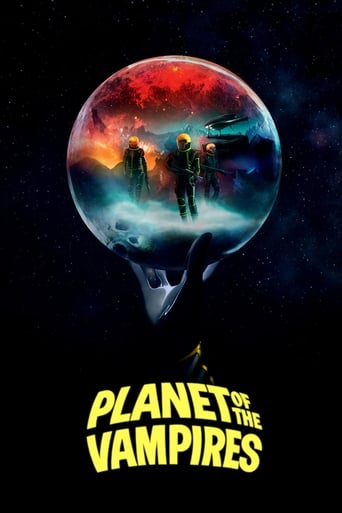
Planet of the Vampires (1965)
Terrore nello spazio
This was the day the universe trembled before the demon forces of the killer planet!
After landing on a mysterious planet, a team of astronauts begin to turn on each other, swayed by the uncertain influence of the planet and its strange inhabitants.
- Date of release
- 1965-09-15
- TMDB
- 6.4 / 10 (267)
- Runtime
- 1h 28m
- Genres
- Science Fiction, Horror, Adventure, Action
- Director
- Mario Bava
Casting
- Barry Sullivan — Captain Mark Markary
- Norma Bengell — Sanya
- Ángel Aranda — Wess
- Evi Marandi — Tiona
- Stelio Candelli — Brad / Mud
- Franco Andrei — Bert / Garr
- Fernando Villena — Dr. Karan
- Mario Morales — Eldon
- Ivan Rassimov — Carter / Dervy
- Federico Boido — Keir
- Alberto Cevenini — Toby Markary / Wan
- Massimo Righi — Captain Sallas / Nordeg
Interesting facts
- Budget: $200K
Planet of the Vampires is a 1965 science fiction horror film directed and co-written by Mario Bava, produced by Fulvio Lucisano, and starring Barry Sullivan and Norma Bengell. The screenplay was based on an Italian-language science fiction short story, Renato Pestriniero's "One Night of 21 Hours". Despite the American title there are no vampires in the movie. The film follows the horrific experiences of the crew members of two giant spaceships that have crash landed on a foreboding, unexplored planet. The disembodied inhabitants of the world possess the bodies of the crew who died during the crash, and use the animated corpses to stalk and kill the remaining survivors.
Production
American International Pictures had achieved a great deal of commercial success in the early 1960s with Bava's Black Sunday (1960) and Black Sabbath (1963), as well as dozens of lesser Italian films, including several sword and sandal pictures. Eventually, AIP heads Samuel Z. Arkoff and James H.
American Barry Sullivan and Brazilian Norma Bengell led the cast of international actors. Before Bengell was cast, AIP regular and Arkoff's wife Susan Hart was considered for the female lead. Filmmaker Robert J. Skotak reported that each cast member "used their own native language on the set, in many cases not understanding what the other actors were saying." Sullivan's lines were spoken in English, Bengell's in Portuguese, Evi Marandi's in Itali…
Restricted by a low budget, Bava was unable to utilize many opticals, so nearly all of the film's extensive visual effects work were done "in camera". Miniatures and forced perspective visuals are used throughout, with much colored fog adding atmosphere but also obscuring the sheer cheapness of the sets.
According to Tim Lucas, the two plastic rocks were multiplied in several shots by mirrors and multiple exposures. The planet's exterior sequences were filmed on an empty stage obscured by mists, table top miniatures and Schüfftan process shots.
Read on Wikipedia · Text from Wikipedia, CC BY-SA 4.0. Data from Wikidata.
Recommended
- Valerian and the City of a Thousand Planets 2017 · ★ 6.7
- Star Trek Beyond 2016 · ★ 6.8
- The Host 2013 · ★ 6.3
- The Creator 2023 · ★ 7.0
- Oblivion 2013 · ★ 6.7
- Stargate: Continuum 2008 · ★ 7.1
- Star Trek Into Darkness 2013 · ★ 7.3
- Surrogates 2009 · ★ 6.2
- Geostorm 2017 · ★ 6.1
- Star Trek 2009 · ★ 7.4
- Guardians of the Galaxy 2014 · ★ 7.9
- Star Wars: The Rise of Skywalker 2019 · ★ 6.2