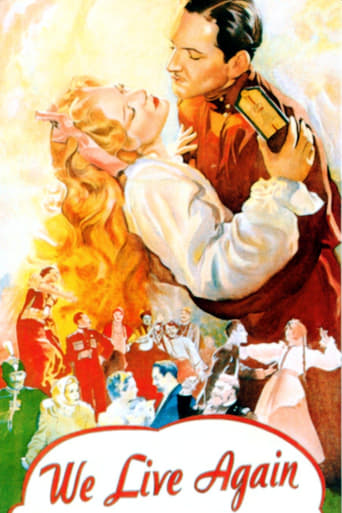
We Live Again (1934)
Two...who went through hell to find their heaven!
Nekhludoff, a Russian nobleman serving on a jury, discovers that the young girl on trial, Katusha, is someone he once seduced and abandoned and that he himself bears responsibility for reducing her to crime. He sets out to redeem her and himself in the process.
- Date of release
- 1934-11-01
- TMDB
- 6.8 / 10 (6)
- Runtime
- 1h 25m
- Genres
- Drama
- Director
- Rouben Mamoulian
Casting
- Anna Sten — Katusha Maslova
- Fredric March — Prince Dmitri Nekhlyudov
- Jane Baxter — Missy Kortchagin
- C. Aubrey Smith — Prince Kortchagin
- Sam Jaffe — Gregory Simonson
- Ethel Griffies — Aunt Marie
- Gwendolyn Logan — Aunt Sophia
- Jessie Ralph — Matrona Pavlovna
- Leonid Kinskey — Simon Kartinkin
- Dale Fuller — Eugenia Botchkova
- Morgan Wallace — The Colonel
- Crauford Kent — Schonbock
Interesting facts
We Live Again is a 1934 American film directed by Rouben Mamoulian and starring Anna Sten and Fredric March. The film is an adaptation of Leo Tolstoy's 1899 novel Resurrection (Voskraeseniye). The screenplay was written by Maxwell Anderson with contributions from a number of writers, including Preston Sturges and Thornton Wilder.
Production
Unlike many films concerning illicit sex made in the 1930s, We Live Again, which had the working title of "Resurrection", met with the approval of the censors at the Hays Office. Joseph Breen wrote to Will H. Hays: "Though dealing with a sex affair and its attendant consequences, the story has been handled with such fine emphasis on the moral values of repentance and retribution, as to emerge with a definite spiritual quality.
The film was in production from 12 June to 2 August 1934. The New York opening took place during the week of 1 November of that year, with the general American release on 16 November.
We Live Again was the third film version of Resurrection in seven years. It had been made as a silent film, under its original title, in 1927, and again under its original title, as an early talkie starring John Boles in 1931. The story has not been made into a theatrical film version in English since We Live Again.
The opening sequences depict the Russian peasantry as they appeared in the 19th century during which Tolstoy's Resurrection is set as well as during Mamoulian's youth, in the final years of the Romanov czarist regime. The cinematography, by Gregg Toland emulates post-revolutionary Soviet films of Sergei Eisenstein and Alexander Dovzhenko
“From the outset, one is translated into the feel and smell of an alien land in a montage of eight brief, low-angled shots which effortlessly capture the glistening, sensuous luster of Dovzhenko’s vision of a new, burgeoning land.”
Read on Wikipedia · Text from Wikipedia, CC BY-SA 4.0. Data from Wikidata.
Recommended
- Hurry Sundown 1967 · ★ 6.4
- Eleanor the Great 2025 · ★ 6.8
- Fast Girls 2012 · ★ 6.0
- Adopt a Highway 2019 · ★ 6.9
- Rocky IV 1985 · ★ 7.1
- House of Bamboo 1955 · ★ 6.2
- Jimmy P. 2013 · ★ 6.1
- Bobby Jones: Stroke of Genius 2004 · ★ 5.9
- Cradle Will Rock 1999 · ★ 6.5
- The Last Bus 2021 · ★ 6.5
- Flicka 2006 · ★ 6.9
- The Fugitive 1947 · ★ 6.0