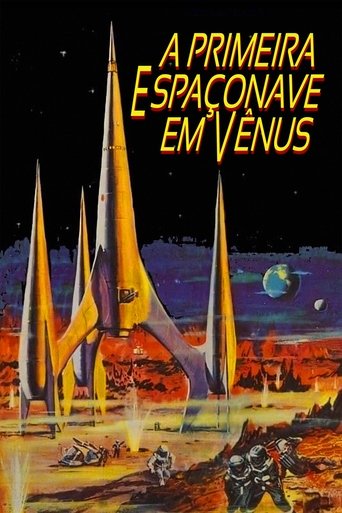
A Primeira Espaçonave em Vênus (1960)
Der schweigende Stern
No distante ano de 1985, quando a Terra seria um lugar de harmonia e fraternidade, um misterioso artefato encontrado na Sibéria é uma mensagem de Vênus, que levará um grupo de cientistas arrojados e das mais variadas etnias a embarcar num foguete em direção ao distante e misterioso planeta.
- Data de estreia
- 1960-02-26
- TMDB
- 4.9 / 10 (84)
- Duração
- 1 h 33 min
- Géneros
- Ficção científica
- Realizador
- Kurt Maetzig
Elenco
- Oldřich Lukeš — Prof. Harringway Hawling
- Ignacy Machowski — Prof. Saltyk
- Julius Ongewe — Talua, afrikanischer Fernsehtechniker
- Mikhail Postnikov — Prof. Arsenew
- Kurt Rackelmann — Prof. Sikarna
- Günther Simon — Robert Brinkmann, deutscher Pilot
- Hua-Ta Tang — Dr. Tchen Yu
- Lucyna Winnicka — Joan Moran
- Yoko Tani — Sumiko Ogimura, japanische Ärztin
- Ruth-Maria Kubitschek — Frau Arsenjew
- Eva-Maria Hagen — Reporterin
- Karen Fredersdorf — Binkmans Mutter
Curiosidades
- Baseado em: The Astronauts
- Filmado em: Alemanha
Der schweigende Stern is a 1960 East German/Polish color science fiction film based on the 1951 science fiction novel The Astronauts by Polish science fiction writer Stanisław Lem. In Poland, the film was known as Milcząca Gwiazda. The film was directed by Kurt Maetzig, and stars Günther Simon, Julius Ongewe, and Yoko Tani. It was first released in February 1960 by Progress Film in East Germany, running 95 min. It was released in the US on 31 October 1962 retitled First Spaceship on Venus.
Production
The story is based on the 1951 science fiction novel The Astronauts by Stanisław Lem. Lem was approached by Kurt Maetzig from DEFA with an idea to make a film adaptation of Lem's novel, possibly because Lem was widely known in Poland and abroad at the time. The Astronauts was likely chosen due to the recent advancements in rocket technology and the popularity of space travel in science fiction.
The DEFA director Herbert Volkmann, responsible for finance, as well as other officials of the GDR, were strict with the project: they had ideological concerns about the script, and new writers were brought in to work on it. Eventually, twelve different versions of the script were created.
In the film's original East German and Polish release, the Earth spaceship sent to Venus is named Kosmokrator.
The film was shot mostly in East Germany. The outdoors scenes were shot in the area of Zakopane, Poland and the airfield of Berlin-Johannisthal and special effects in Babelsberg Studio and in a studio in Wrocław, Poland. The spaceship mock-up at the airfield became the subject of a hoax in the newspaper Der Kurier: the front page presented the spaceship as a failed attempt at spaceflight in the Soviet occupation zone.
The film was noted for early extensive usage of "electronic sounds" on its soundtrack. Electronic music and noises illustrated the work of the computer that deciphers the alien message, the message itself, and the eerie landscape of Venus devastated by the nuclear catastrophe.
Ler na Wikipédia · Texto da Wikipédia, CC BY-SA 4.0. Dados do Wikidata.
Recomendados
- Han Solo: Uma História de Star Wars 2018 · ★ 6.5
- Passageiro Acidental 2021 · ★ 6.0
- Viagem ao Outro Lado do Sol 1969 · ★ 6.3
- Eles Chegaram 1996 · ★ 6.0
- Mission Galactica: The Cylon Attack 1979 · ★ 7.0
- Star Trek: Insurreição 1998 · ★ 6.5
- Gravidade 2013 · ★ 7.2
- Leroy & Stitch 2006 · ★ 6.5
- Star Wars: Episódio IX - A Ascensão de Skywalker 2019 · ★ 6.2
- S.O.S. Metaluna 1955 · ★ 6.0
- The Adventures of Buckaroo Banzai Across the 8th Dimension 1984 · ★ 6.0
- Star Trek: Além do Universo 2016 · ★ 6.8