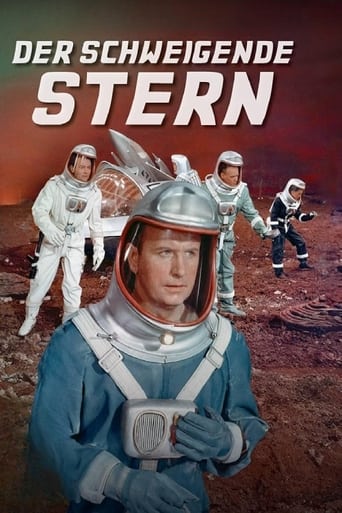
前往金星的第一艘太空飞船 (1960)
Der schweigende Stern
A mysterious magnetic spool found during a construction project is discovered to have originated from Venus. A rocket expedition to Venus is launched to discover the origin of the spool and the race that created it.
- 上映日期
- 1960-02-26
- TMDB
- 4.9 / 10 (84)
- 片长(分钟)
- 1小时33分钟
- 类型
- 科幻
- 导演
- Kurt Maetzig
演员阵容
- Oldřich Lukeš — Prof. Harringway Hawling
- Ignacy Machowski — Prof. Saltyk
- Julius Ongewe — Talua, afrikanischer Fernsehtechniker
- Mikhail Postnikov — Prof. Arsenew
- Kurt Rackelmann — Prof. Sikarna
- Günther Simon — Robert Brinkmann, deutscher Pilot
- Hua-Ta Tang — Dr. Tchen Yu
- Lucyna Winnicka — Joan Moran
- Yoko Tani — Sumiko Ogimura, japanische Ärztin
- 露丝·玛丽亚·库比切克 — Frau Arsenjew
- Eva-Maria Hagen — Reporterin
- Karen Fredersdorf — Binkmans Mutter
趣闻
- 改编自:太空人 (小說)
- 拍摄地:德國
Der schweigende Stern is a 1960 East German/Polish color science fiction film based on the 1951 science fiction novel The Astronauts by Polish science fiction writer Stanisław Lem. In Poland, the film was known as Milcząca Gwiazda. The film was directed by Kurt Maetzig, and stars Günther Simon, Julius Ongewe, and Yoko Tani. It was first released in February 1960 by Progress Film in East Germany, running 95 min. It was released in the US on 31 October 1962 retitled First Spaceship on Venus on a double bill with the 1958 Japanese film ''Varan the Unbelievable''.
Production
The story is based on the 1951 science fiction novel The Astronauts by Stanisław Lem. Lem was approached by Kurt Maetzig from DEFA with an idea to make a film adaptation of Lem's novel, possibly because Lem was widely known in Poland and abroad at the time. The Astronauts was likely chosen due to the recent advancements in rocket technology and the popularity of space travel in science fiction.
The DEFA director Herbert Volkmann, responsible for finance, as well as other officials of the GDR, were strict with the project: they had ideological concerns about the script, and new writers were brought in to work on it. Eventually, twelve different versions of the script were created.
In the film's original East German and Polish release, the Earth spaceship sent to Venus is named Kosmokrator.
The film was shot mostly in East Germany. The outdoors scenes were shot in the area of Zakopane, Poland and the airfield of Berlin-Johannisthal and special effects in Babelsberg Studio and in a studio in Wrocław, Poland. The spaceship mock-up at the airfield became the subject of a hoax in the newspaper Der Kurier: the front page presented the spaceship as a failed attempt at spaceflight in the Soviet occupation zone.
The film was noted for early extensive usage of "electronic sounds" on its soundtrack. Electronic music and noises illustrated the work of the computer that deciphers the alien message, the message itself, and the eerie landscape of Venus devastated by the nuclear catastrophe.
在维基百科阅读更多 · 文本来自维基百科,CC BY-SA 4.0。数据来自 Wikidata。
推荐
- 质量效应:迷途楷模 2012 · ★ 6.2
- 星球大战外传2:游侠索罗 2018 · ★ 6.5
- 偷渡者 2021 · ★ 6.0
- 星际争霸:赛隆人出击 1979 · ★ 7.0
- 地心引力 2013 · ★ 7.2
- 星球大战9:天行者崛起 2019 · ★ 6.2
- 天生爱神 1984 · ★ 6.0
- 星际迷航3:超越星辰 2016 · ★ 6.8
- 银河对决 1978 · ★ 6.8
- 星际之门:时空连续 2008 · ★ 7.1
- 银河护卫队 2014 · ★ 7.9
- 遗落战境 2013 · ★ 6.7