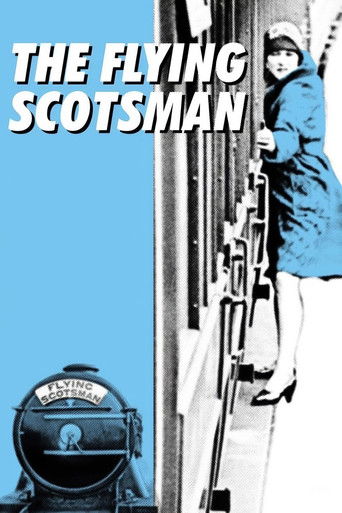
The Flying Scotsman (1929)
All Aboard — For The Flying Scotsman
The Flying Scotsman is a 1929 black and white film set on the Flying Scotsman train from London to Edinburgh. Engine driver Bob is due to retire from his job after years of distinguished service. On his second to last day he reports Crow, a disgruntled fireman for drinking at work, leading to his dismissal. The sacked man decides to get his revenge, vowing to kill Bob on his final run. Meanwhile, Crow's young replacement has fallen in love with a beautiful girl, whose father, unbeknown to him, happens to be Bob (and who has also boarded the train in an attempt to stop the villain).
- Date of release
- 1929-05-30
- TMDB
- 7.1 / 10 (10)
- Runtime
- 50m
- Genres
- Drama, Crime
- Director
- Castleton Knight
Casting
- Gordon Harker
- Pauline Johnson — Joan White
- Moore Marriott — Bob White
- Ray Milland — Jim Edwards
- Alec Hurley — Crow
Interesting facts
The Flying Scotsman is a 1929 British black and white part-talkie film directed by Castleton Knight and starring Moore Marriott, Pauline Johnson, Ray Milland and Alec Hurley. It was written by Victor Kendall and Garnett Weston. The film is set on the Flying Scotsman train from London to Edinburgh, also featuring the famous locomotive LNER Class A3 4472 Flying Scotsman. In addition to sequences with audible dialogue or talking sequences, the film features a synchronized musical score and sound effects along with English intertitles. The film is notable for being the first leading acting role of Ray Milland, and for its daring stunts performed aboard the moving train.
Production
The film was shot with co-operation of the London and North Eastern Railway company, who allocated their flagship Class A1 locomotive, the eponymous 4472 Flying Scotsman along with use of the Hertford Loop Line for filming. This locomotive was extensively used by the LNER for promotional purposes, having been a star of the 1924 British Empire Exhibition and breaking a number of speed records.
All of the stunts were filmed on the moving locomotive with the actors. Most dangerously, at one point actress Pauline Johnson walks along the edge of the moving train wearing high heeled shoes, transferring from the coaches to the locomotive while travelling at speed.
Allegedly Sir Nigel Gresley, chief engineer of the LNER, was so concerned at the unsafe practices shown in the film, such as the decoupling of the locomotive from the train while in motion, he insisted that a disclaimer was placed in the opening credits explaining that such things could not happen on the LNER.
Along with Alfred Hitchcock's Blackmail, this was one of the first British sound films. Like that film, it was initially intended to be a silent film, with the decision to switch to speech made during production. As a result, early scenes feature speech captions and music instead of recorded voices, with character dialogue only appearing towards the end of the film.
Read on Wikipedia · Text from Wikipedia, CC BY-SA 4.0. Data from Wikidata.
Recommended
- Plunder Road 1957 · ★ 6.9
- The Unforgivable 2021 · ★ 7.4
- Cigarettes & Coffee 1993 · ★ 6.6
- In the Blood 2014 · ★ 5.8
- The Parts You Lose 2019 · ★ 6.7
- Panic 2000 · ★ 6.2
- Sleep, My Love 1948 · ★ 6.3
- Wanda 1970 · ★ 6.8
- Winged Creatures 2009 · ★ 5.9
- Framed 1947 · ★ 6.5
- TalhotBlond 2012 · ★ 6.3
- Union Pacific 1939 · ★ 6.7