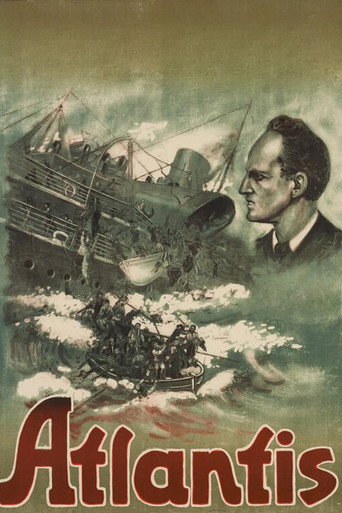
Atlantis (1913)
Overwhelmed by personal and professional problems, biologist Friedrich von Kammacher decides to travel abroad in order to regain the joy of living. During his adventurous journey he will meet two very different women, one of whom will be the key to his fate.
- Date of release
- 1913-12-20
- TMDB
- 5.9 / 10 (15)
- Runtime
- 1h 57m
- Genres
- Drama
- Director
- August Blom
Casting
- Olaf Fønss — Dr. Friedrich von Kammacher
- Frederik Jacobsen — Dr. Rasmussen
- Carl Lauritzen — Dr. Peter Schmidt
- Ida Orloff — Ingigerd Hahlstrøm – Dancer
- Ebba Thomsen — Eva Burns – Sculptor
- Charles Unthan — Arthur Stoss – Artist
- Alma Hinding — Russian Refugee
- Torben Meyer — Willy Snyders
- Cajus Bruun — Friedrich's Father
- Christian Schrøder — Ingigerd's Father
- Franz Skondrup — Stoss' Servant
- Svend Kornbeck — Captain
Interesting facts
Atlantis is a 1913 Danish silent film directed by August Blom, the head of production at the Nordisk Film company, and was based upon the 1912 novel by Gerhart Hauptmann. It starred an international cast headlined by Danish matinée actor Olaf Fønss and Austrian stage actress Ida Orloff. The film tells the tale of a doctor who travels to the United States in search of a cure for his ailing wife and of the tragic sinking of an ocean liner after it strikes an object at sea. Released only one year after the sinking of the RMS Titanic, the film drew considerable attention as well as criticism due to similarities to the actual tragedy.
Production
Due to the large number of cast, extras, and locations, and the amount of equipment, Blom took the unusual step of employing two assistant directors for filming. The first was Robert Dinesen who later had his own successful career as a director with Nordisk Film in Denmark and Germany.
To film the shipboard scenes, Nordisk Film chartered the Danish ocean liner C. F. Tietgen. However, the Atlantis sinking scene used a large-scale model and about 500 extras as swimmers, and was filmed in the bay off Køge, Denmark.
Blom filmed two endings for the movie—one happy and one tragic. The alternate tragic ending, in which the Doctor dies at the end, was made in particular for the Russian market. It was believed that the Russians had a preference for sad endings.
Some sources claimed that the sinking ship scenes were inspired by the Titanic sinking which had occurred the previous year. However, Blom based his film entirely on Gerhardt Hauptmann's 1912 novel, Atlantis. Hauptmann's novel was published in serialized form in the Berliner Tageblatt a month before the Titanic disaster. Nevertheless, due to the film's release only one year after the Titanic sinking, Atlantis became associated with the Titanic.
Because his original story was partly autobiographical, Hauptmann's contract with Nordisk Film required two roles be acted by the actual people who were their inspiration. A letter from Nordisk Film to Fred A. Talbot of England explained, "...the part of "Ingigerd" and the armless virtuoso "Arthur Stoss" were played by the very same persons, who where [sic], so to speak, used as models by Gerhart Hauptmann, when he wrote his famous novel.
Read on Wikipedia · Text from Wikipedia, CC BY-SA 4.0. Data from Wikidata.
Recommended
- The Poseidon Adventure 1972 · ★ 7.2
- Conspiracy 2001 · ★ 7.3
- Alone in Berlin 2016 · ★ 6.7
- Wonderstruck 2017 · ★ 6.1
- Shutter Island 2010 · ★ 8.2
- Despair 1978 · ★ 6.5
- Berlin Express 1948 · ★ 6.3
- 25th Hour 2002 · ★ 7.3
- The Secret Woman 2026 · ★ 6.5
- The Talented Mr. Ripley 1999 · ★ 7.2
- A Dangerous Method 2011 · ★ 6.3
- Asphalt City 2024 · ★ 6.2