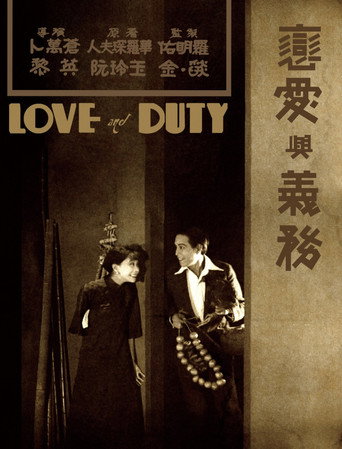
戀愛與義務 (1931)
The film tells the story of Yang Naifan (Ruan Lingyu) who runs from her arranged marriage to be with her true love, Li Zuyi (Jin Yan). The film details the poverty she must endure for breaking with tradition.
- Erscheinungsdatum
- 1931-01-18
- TMDB
- 7.3 / 10 (7)
- Laufzeit
- 2 Std. 32 Min.
- Genres
- Drama
- Regie
- Bu Wan-Cang
Besetzung
- Ruan Lingyu — Yang Nai Fan
- 刘继群 — Mr. Yang
- Jin Yan — Li Zuyi
- 陈燕燕
- Huang Shaofen — Huang Guanxiong
- Zhou Lili — Zhang Ying, the confidant of Da Ren Gongyu
- 高威廉 — Guan Kesheng
- Yiwen Wang — Ma-li, Guanxiong's lover
- Bolu Ouyang — Guan Eng
- Yingying Guo — Guan Dahua
- Juyun Yu — Mother of Li Zuyi
- 黎英 — Huang Da-ren
Wissenswertes
Love and Duty is a 1931 Chinese silent film, directed by Bu Wancang and starring Ruan Lingyu and Jin Yan. Though very successful upon initial release in China, the film was then lost for decades before it was rediscovered in Uruguay in the 1990s. It is now housed at the Taiwan Film and Audiovisual Institute.
Production history
Released in April 1931, the film is based on the novel, Love and Duty, by a Polish-Jewish expatriate living in Beijing, S. Rosen-Hoa (also known as S. Horose and Hua Luo Chen).
The novel Love and Duty written by Rosen-Hoa was first published in Chinese in 1923 as eight installments in the literary magazine The Story World (xiaoshuo shijie / 小說世界). It was then released as a stand-alone novel the following year. An English-language version was then released in 1926 and a French-language version under the title La Symphonie des Ombres Chinoises (A Symphony of Chinese Shadowplay) in 1932.
Rosen-hoa gave a copy of her novel to Lo Ming-Yau, the future producer of the film, in 1923. Ming-Yau thought that the novel, with its sophisticated plot, should be adapted to film. However, it would not be until eight years later, after Ming Yau formed the United Photoplay Service (also referred to as Lianhua Film Company) alongside Lai Man-Wai, that this project would come to fruition and the film was finally made.
The film was attributed to both United Photoplay Service and China Sun Motion Picture Co., the film company headed by Lai Man-Wai that was absorbed into United Photoplay Service upon its formation, as United Photoplay Service was not yet registered when shooting began.
The newly established United Photoplay Service had the stated goal of raising the standard of domestic productions to match the quality of foreign imports that dominated China's market, and reach new audiences overseas. As one of the first films ever produced by the company, this mission can be seen in its promotion of the film in both English and Chinese-language newspapers at the time of its release, as well as the decision to include bilingual…
Auf Wikipedia weiterlesen · Text aus Wikipedia, CC BY-SA 4.0. Daten aus Wikidata.
Empfohlen
- Eine Sekunde 2020 · ★ 7.3
- Buddha Mountain 2011 · ★ 6.7
- Rogue Agent 2022 · ★ 6.3
- Back to Back, Face to Face 1994 · ★ 8.3
- Hello 2022 · ★ 6.3
- Hounddog 2008 · ★ 6.5
- Fast Girls: Lauf für deinen Traum 2012 · ★ 6.0
- Caught by the Tides 2024 · ★ 6.7
- Schutzlos - Schatten über Carolina 1996 · ★ 7.1
- TalhotBlond - Mörderische Lügen 2012 · ★ 6.3
- Padre 2018 · ★ 5.9
- The Enforcer 2022 · ★ 7.0