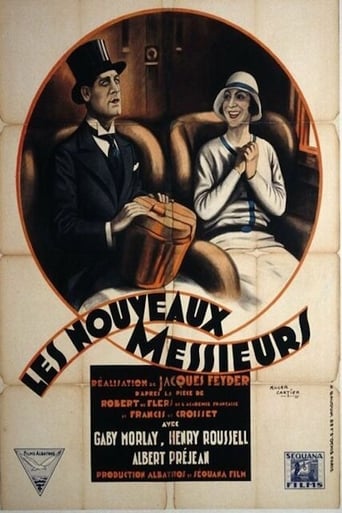
The New Gentlemen (1929)
Les Nouveaux Messieurs
The plot focuses on Gaillac (Albert Prejean), an electrician employed by the Paris Opera. In love with gorgeous ballerina Suzanne (Gaby Morlay), Gaillac must play second fiddle to Suzanne's wealthy "protector," powerful politician Count Montoire (Henry Roussell). When the Opera personnel go on strike, Gaillac is appointed leader of the strikers, doing his job so well that he is ultimately elected Secretary of Labor in the French cabinet. Now on equal footing with Montoire, Gaillac is at last a "worthy" suitor for Suzanne -- who can't make up her mind between her two well-connected admirers, leading to a political rivalry the likes of which Paris has never seen. This harmless political satire ended up being banned by the French government for undermining "the dignity of Parliament and its ministers". (moviefone.com)
- Date of release
- 1929-04-05
- TMDB
- 6.5 / 10 (10)
- Runtime
- 2h 3m
- Genres
- Drama, Romance, Comedy
- Director
- Jacques Feyder
Casting
- Albert Préjean — Jacques Gaillac
- Gaby Morlay — Susanne Verrier
- Charles Barrois — Theatre director
- Henry Roussel — Comte de Montoire Grandpre
- Léon Arvel — President
- Guy Ferrant — Reporter
- Henri Valbel — Policeman Morin
- Gustave Hamilton — L' Huissier
- Georges Deneubourg — De Courcieux
- Christian Gérard
- Raymond Narlay — Chief de Cabinet
- Bill Bocket
Interesting facts
Les Nouveaux Messieurs is a 1929 French silent film directed by Jacques Feyder. It is a satirical comedy, whose initial release in France was delayed for several months because of objections to its portrayal of the French parliament.
Production
The success of Jacques Feyder's adaptation of Thérèse Raquin brought him an invitation from MGM to work in Hollywood, but before he left, he agreed to one further film in France for Alexandre Kamenka's Albatros company which was in economic difficulties. Feyder was offered complete artistic freedom on the project and chose to adapt a recent stage comedy which combined romantic drama with political satire.
Les Nouveaux Messieurs by Robert de Flers and Francis de Croisset had opened in Paris in February 1925, with Gaby Morlay in the leading role, and it became the biggest success of the season, running for over 500 performances. Feyder and Charles Spaak made an adaptation which sought to dispense with the verbal humour of the play but to translate it into visual terms.
The production was filmed principally at the Billancourt studios during the summer of 1928, and it features some elaborate set designs by Lazare Meerson (including a reconstruction of the Chambre des Deputés, a stylish Parisian town house, and rehearsal areas at the Opéra). One of the assistant cameramen working with Georges Périnal was the 22-year-old Marcel Carné.
Read on Wikipedia · Text from Wikipedia, CC BY-SA 4.0. Data from Wikidata.
Recommended
- Two Friends 2015 · ★ 5.8
- Everybody Loves Jeanne 2022 · ★ 6.1
- Madame 2017 · ★ 5.9
- Waiting for Bojangles 2021 · ★ 7.3
- Strictly Sexual 2008 · ★ 6.1
- XX/XY 2002 · ★ 6.0
- The Diary of a Chambermaid 1946 · ★ 6.2
- Le Plaisir 1952 · ★ 7.5
- Our Story 1984 · ★ 6.3
- Anaïs in Love 2021 · ★ 6.2
- Diary of a Fleeting Affair 2022 · ★ 6.4
- How to Please a Woman 2022 · ★ 6.3