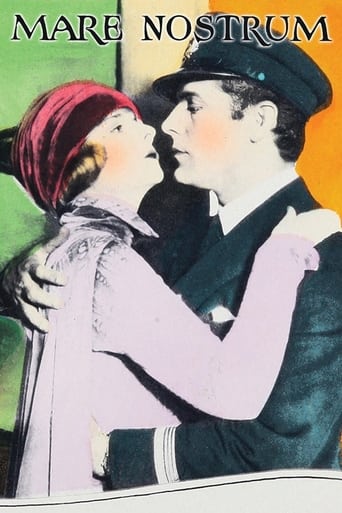
Mare Nostrum (1926)
The story of a female German spy who willingly sacrifices her life for her country.
- Date of release
- 1926-02-15
- TMDB
- 5.9 / 10 (14)
- Runtime
- 1h 42m
- Genres
- War, Drama
- Director
- Rex Ingram
Casting
- Apollon Uni — The Triton (prologue) (as Uni Apollon)
- Álex Nova — Don Esteban Ferragut (prologue) (as Alex Nova)
- Kada-Abd-el-Kader — Don Esteban's Son - Ulysses (prologue)
- Hughie Mack — Caragol (prologue)
- Alice Terry — Freya Talberg
- Antonio Moreno — Ulysses Ferragut
- Mademoiselle Kithnou — Ferragut's Wife - Dona Cinta (as Mle. Kithnou)
- Mickey Brantford — Ferragut's Son - Esteban (as Michael Brantford)
- Rosita Ramírez — Ferragut's Niece - Pepita
- Frédéric Mariotti — Toni - the Mate (as Fredrick Mariotti)
- Madame Pâquerette — Doctor Fedelmann (as Mme. Paquerette)
- Fernand Mailly — Count Kaledine
Interesting facts
Mare Nostrum is a 1926 American silent war drama film directed by Rex Ingram. It was the first production made by Ingram while in voluntary exile and stars Ingram's wife, Alice Terry. The film is set during World War I, and follows a Spanish merchant sailor who becomes involved with a German spy. It is based on the novel of the same name by Vicente Blasco Ibáñez. Long thought lost, the film was re-discovered in 1994.
Production
Rex Ingram's reputation as an outstanding Hollywood director rested on the enormous success of his 1921 The Four Horsemen of the Apocalypse, a film adaption of Spanish novelist Vicente Blasco Ibáñez ’s work that had, according to Kevin Brownlow “made a star of Valentino, saved Metro Pictures from bankruptcy, and earned the director the undying gratitude of the head of Metro, Marcus Loew.” Ingram was determined to adapt another Ibáñez novel, his 1…
Ingram purchased the former Gaumont studio located in Nice, France, financed by M-G-M preliminary to making Mare Nostrum. The facility required extensive upgrades, and regional technical services support was inadequate.
“The glass roofs of the [Gaumont] studio created a furnace in the daytime, while at night, when a lot of the filming took place, arctic temperatures were recorded...French laboratories were found to be unsatisfactory. The London laboratories were too far away. Equipment set up in the studios developed defects and much negative was found to be unusable and necessitated many retakes.
The film adaptation required location shooting in France, Italy and Spain, obliging Ingram to allot the sequences shot in Barcelona to his cinematographer John F. Seitz. Mare Nostrum took 15 months to complete.
A highly regarded sequence in Mare Nostrum depicts spy Freya Talberg's execution by German authorities for treason. Film archivist Kevin Brownlow describes it as “perhaps the finest sequence Ingram ever shot.” Film historian Charles Higham describes Ingram's cinematic handling of her demise:
Read on Wikipedia · Text from Wikipedia, CC BY-SA 4.0. Data from Wikidata.
Recommended
- Operation Mincemeat 2022 · ★ 6.5
- Britannic 2000 · ★ 6.8
- The Scarlet and the Black 1983 · ★ 7.1
- The One That Got Away 1957 · ★ 6.8
- Munich - The Edge of War 2021 · ★ 6.9
- Waiting for Anya 2020 · ★ 6.3
- The War Below 2021 · ★ 6.6
- Decision Before Dawn 1951 · ★ 6.8
- The Counterfeit Traitor 1962 · ★ 6.5
- The Man Who Never Was 1956 · ★ 7.0
- Flyboys 2006 · ★ 6.5
- An Ordinary Man 2017 · ★ 6.2