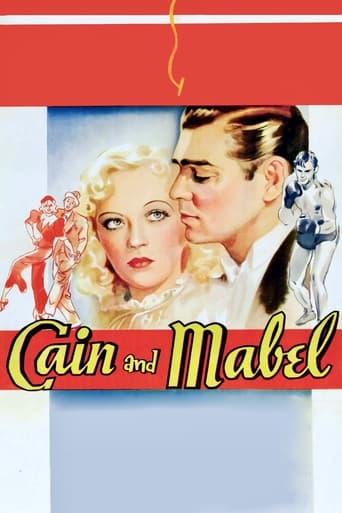
凯恩与梅布尔 (1936)
Cain and Mabel
A chorus girl and a heavyweight boxer are paired romantically as a publicity stunt.
演员阵容
- Marion Davies — Mabel O'Dare
- 克拉克·盖博 — Larry Cain
- Allen Jenkins — Dodo
- 罗斯科·卡恩斯 — Reilly
- Walter Catlett — Jake Sherman
- Robert Paige — Ronny Cauldwell
- Hobart Cavanaugh — Milo
- Ruth Donnelly — Aunt Mimi
- Pert Kelton — Toddy
- William Collier Sr. — Pop Walters
- Sammy White — Specialty - Coney Island Number
- E. E. Clive — Charles Fendwick
趣闻
Cain and Mabel is a 1936 American romantic comedy film directed by Lloyd Bacon and designed as a vehicle for Marion Davies in which she co-stars with Clark Gable. The story had been filmed before, in 1924, by William Randolph Hearst's production company, Cosmopolitan, as a silent called The Great White Way, starring Anita Stewart and Oscar Shaw. In this version, Robert Paige introduced the song "I'll Sing You a Thousand Love Songs", with music by Harry Warren and words by Al Dubin, who also wrote "Coney Island", "Here Comes Chiquita", and other songs.
Production and reception
Marion Davies, whose acting career was supported by her lover William Randolph Hearst, left Metro-Goldwyn-Mayer after she failed to receive parts in The Barretts of Wimpole Street and Marie Antoinette. She gained a contract with Warner Bros. Pictures which started with Page Miss Glory and Hearts Divided.
Shooting on Cain and Mabel was delayed because the part of the leading man, which eventually went to Clark Gable, had not yet been cast. Hearst persuaded Warner Bros. studio head Jack L. Warner, an old friend, to get Gable from MGM as Davies' co-star. Hearst wielded considerable influence on the production: he also rejected Dick Powell for the part which went to Robert Paige – billed here as "David Carlyle" – apparently because he was jealous.
The film was shot on Stage 16 at the Warner lot, which was the standard 45 feet tall, but Davies wanted the set to be larger, so she called Warner and requested that they raise the roof of the sound stage. Warner refused until Davies called Hearst and convinced Warner to sign onto the idea, but only if Hearst paid for the renovation. Due to the shooting schedule, they could not do it the standard way and rip the roof off and build up.
在维基百科阅读更多 · 文本来自维基百科,CC BY-SA 4.0。数据来自 Wikidata。