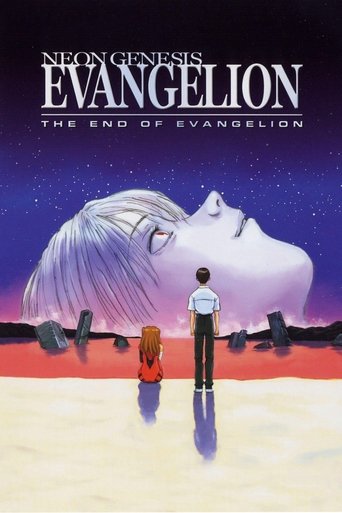
Neon Genesis Evangelion: The End of Evangelion (1997)
新世紀エヴァンゲリオン劇場版 Air/まごころを、君に
The fate of destruction is also the joy of rebirth.
SEELE orders an all-out attack on NERV, aiming to destroy the Evas before Gendo can advance his own plans for the Human Instrumentality Project. Shinji is pushed to the limits of his sanity as he is forced to decide the fate of humanity.
- Date of release
- 1997-07-19
- TMDB
- 8.3 / 10 (1991)
- Runtime
- 1h 27m
- Genres
- Animation, Science Fiction, Drama, Fantasy, Action
- Director
- Kazuya Tsurumaki, Hideaki Anno
- Collection
- Neon Genesis Evangelion Collection
Casting
- Megumi Ogata — Shinji Ikari (voice)
- Megumi Hayashibara — Rei Ayanami / Yui Ikari (voice)
- Kotono Mitsuishi — Misato Katsuragi (voice)
- Yuko Miyamura — Asuka Langley Soryu (voice)
- Fumihiko Tachiki — Gendo Ikari (voice)
- Miki Nagasawa — Maya Ibuki (voice)
- Takehito Koyasu — Shigeru Aoba (voice)
- Hiro Yuuki — Makoto Hyouga (voice)
- Yuriko Yamaguchi — Ritsuko Akagi (voice)
- Motomu Kiyokawa — Kozo Fuyutsuki (voice)
- Akira Ishida — Kaworu Nagisa (voice)
- Mugihito — Keel Lorenz (voice)
Interesting facts
- Based on: Neon Genesis Evangelion
The End of Evangelion is a 1997 Japanese animated apocalyptic science fiction film directed by Hideaki Anno and Kazuya Tsurumaki, written by Anno, and animated by Gainax and Production I.G. It serves as an ending to the anime television series Neon Genesis Evangelion, which aired from 1995 to 1996. The staff had little time to produce the final episodes of the original series, particularly due to Anno's indecision over how to conclude the series and the troubled production schedule. For The End of Evangelion, Gainax revisited ideas that it had previously discarded due to time constraints, particularly for the twenty-fifth episode.
Production
After the first broadcast of the animated series Neon Genesis Evangelion, its ending attracted considerable media attention in Japan. With the broadcast of the first episode, "Angel Attack", animation studio Gainax had only roughly completed twelve of the planned twenty-six episodes after nearly two years of production, forcing the studio to produce the remaining fourteen in about a third of that time.
The two final episodes, which focus on psychological introspection and long inner monologues of the show's main characters, met the expectations of Gainax studio's staff but became a source of discussion for fans; although the finale concluded the most important psychological themes of the series, it abandoned the main plot, giving rise to controversy. The issue was debated throughout Japan, fueling the series' already-high popularity.
On April 26, 1996, about a month after the final episode of the series aired, the magazine Monthly Shōnen Ace announced plans for a remake of the final two episodes. The magazine also announced the production of a new feature-length film.
Gainax originally planned to release the separate feature film in mid-1997. Production of Rebirth, however, fell behind schedule; the staff produced so much material that Gainax had to split it into two releases. In addition, some staff members struggled with the demanding production schedule, prompting Gainax to postpone the new film indefinitely. In March 1997, Gainax released Death and Rebirth.
After the series concluded, Anno entered a difficult psychological state, and his friend and anime director Hayao Miyazaki advised him to take a break. Anno followed his advice and rested for several months. Gainax officially began production of the film version of Neon Genesis Evangelion on November 8, 1996.
Read on Wikipedia · Text from Wikipedia, CC BY-SA 4.0. Data from Wikidata.
Recommended
- Evangelion: 3.0+1.0 Thrice Upon a Time 2021 · ★ 8.2
- Evangelion: 3.0 You Can (Not) Redo 2012 · ★ 7.2
- Neon Genesis Evangelion: Death and Rebirth 1997 · ★ 7.4
- Ghost in the Shell 1995 · ★ 7.9
- Evangelion: 1.0 You Are (Not) Alone 2007 · ★ 7.6
- Ghost in the Shell 2.0 2008 · ★ 7.4
- Made in Abyss: Wandering Twilight 2019 · ★ 8.2
- Altered Carbon: Resleeved 2020 · ★ 6.6
- GANTZ:O 2016 · ★ 7.4
- EVANGELION: DEATH (TRUE)² 1998 · ★ 6.8
- Paprika 2006 · ★ 7.8
- Attack on Titan: THE LAST ATTACK 2024 · ★ 8.8