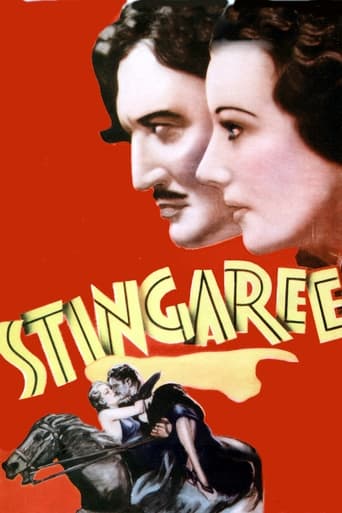
Stingaree (1934)
The Stars of Immortal "Cimmaron" United Again!
A young lady named Hilda who works as a servant for the wealthy Clarksons, sheep farmers, and dreams of being a great singer. An upcoming visit by Sir Julian, a famous composer arriving from London, drives jealous Mrs. Clarkson (an interfering biddy who fancies she can sing - but can't) to send away Hilda, so he doesn't hear Hilda has a good voice. Meanwhile, an infamous outlaw named Stingaree has just arrived in town and kidnaps Sir Julian, then poses as him at the Clarksons, where he meets Hilda a few hours before she is to leave.
- Date of release
- 1934-05-24
- TMDB
- 6.1 / 10 (11)
- Runtime
- 1h 17m
- Genres
- Comedy, Adventure, Romance
- Director
- William A. Wellman
Casting
- Irene Dunne — Hilda Bouverie
- Richard Dix — Stingaree
- Mary Boland — Mrs. Clarkson
- Conway Tearle — Sir Julian Kent
- Andy Devine — Howie
- Una O'Connor — Annie
- Henry Stephenson — Mr. Hugh Clarkson
- George Barraud — Inspector Radford
- Harry 'Snub' Pollard — Victor
- Reginald Owen — The Governor-General
- Billy Bevan — Mac
- Robert Greig — The Innkeeper
Interesting facts
Stingaree is an American pre-Code romantic drama film directed by William A. Wellman released by RKO Radio Pictures in 1934. The film was based on a 1905 novel by Ernest William Hornung. Set in Australia, it stars Irene Dunne as Hilda Bouverie and Richard Dix as Stingaree. Hollywood had previously filmed the Hornung story as serials in 1915 and 1917, starring True Boardman.
Production
In June 1933, RKO, then under production chief Merian C. Cooper, purchased rights to the stories as a vehicle for Irene Dunne. The story was described as being about an "Australian Robin Hood."
Producer David Lewis said he was asked to make it by Cooper as he was too busy. "After reading it, I found it something less than easy to warm up to," wrote Lewis. "Coop knew that but still wanted me to try it."
Lewis got in Lynn Riggs and Leonard Spiegelglass to write the script which the producer called "a bugger... it was just murder. Everything they brought in was loose and undramatic. Riggs was a very good dramatist and Spigelgass had an impressive gift for dialogue, but somehow it just didn’t jell. Basically it wasn’t much of a story; it had no structure.
In October 1933 Dunne signed a new two-year contract with RKO the first film of which was to be Stingaree with Richard Dix, with whom she had made the highly successful Cimarron. Later that month RKO announced the male lead would be Leslie Banks with Ernest B. Schoesdak to direct. Then Banks left to sign a contract with Fox.
RKO decided to replace him with John Boles, but he was not available, pushing back shooting so Dunne could make Age of Innocence. Then Boles dropped out and RKO decided to use Dix.
Read on Wikipedia · Text from Wikipedia, CC BY-SA 4.0. Data from Wikidata.
Recommended
- The Pirate 1948 · ★ 6.5
- Arlo the Alligator Boy 2021 · ★ 6.8
- Joe Versus the Volcano 1990 · ★ 5.8
- Thoroughly Modern Millie 1967 · ★ 6.9
- Blue's Big City Adventure 2022 · ★ 7.1
- The Secret Life of Walter Mitty 1947 · ★ 6.8
- Watching the Detectives 2007 · ★ 6.3
- Zambezia 2012 · ★ 6.2
- Under the Boardwalk 2023 · ★ 7.3
- My Little Pony: Equestria Girls - Legend of Everfree 2016 · ★ 7.5
- What's Love Got to Do with It? 2023 · ★ 6.1
- Road to Morocco 1942 · ★ 6.9