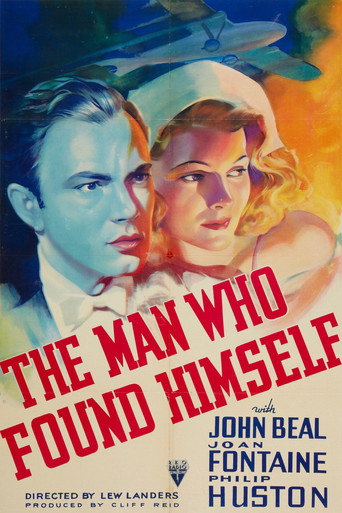
The Man Who Found Himself (1937)
Young Jim Stanton is a conscientious surgeon, but spends too many off-duty hours pursuing his passion for aviation to suit his stuffy father. When it is discovered that a passenger killed in a plane that Jim crashes was a married woman, the resulting scandal prompts the hospital to put Jim on probation. His pride wounded, Jim takes to the open road and enjoys the simpler life of a vagabond. In Los Angeles--where he is arrested for vagrancy and put to work on a road crew--Jim runs into old pal Dick Miller, who gets him a job as a mechanic for Roberts Aviation. But maintaining his anonymity becomes more difficult, particularly when a pretty nurse, Doris King, decides to make Jim's redemption her personal crusade.
- Date of release
- 1937-04-02
- TMDB
- 8.5 / 10 (2)
- Runtime
- 1h 7m
- Genres
- Drama
- Director
- Lew Landers
Casting
- John Beal — Dr. James Stanton Jr.
- Joan Fontaine — Doris King
- Phillip Huston — Richard Miller
- Jane Walsh — Barbara Reed
- George Irving — Dr. James Stanton Sr.
- Jimmy Conlin — Nosey Watson
- Frank M. Thomas — Mr. Roberts
- Diana Gibson — Helen Richards
- Dwight Frye — Hysterical patient
- Billy Gilbert — Fat hobo
- Stanley Andrews — Insp. Grey
- Matthew Betz — Hobo #1
Interesting facts
The Man Who Found Himself, also known as Wings of Mercy, is a 1937 American aviation film based on the unpublished story "Wings of Mercy" by Alice B. Curtis. The film marked the first starring role for 19-year-old Joan Fontaine, who was billed as the "new RKO screen personality", highlighted following the end of the film by a special "on screen" introduction. Unlike many of the period films that appeared to glorify aviation, it is a complex film, examining the motivations of both doctors and pilots.
Production
Although Joan Fontaine, on contract with RKO, had already made her screen appearance in No More Ladies (1935), A Million to One (1937) and Quality Street (1937), opposite Katharine Hepburn , the studio considered her a rising star, and touted The Man Who Found Himself as her first starring role. A unique "photo-play"-style introduction was placed after the end credit.
The Man Who Found Himself featured a number of Lockheed Model 10 Electras, a Ford Trimotor, and other aircraft, while a Waco also served as a camera plane for the aerial sequences. Prolific director Lew Landers, who had gained a reputation for bringing projects in on time and budget, began the production January 12, 1937 and wrapped up principal photography by February 1937.
AFI Catalog lists the source material as a story by Alice F. Curtis but Motion Picture Herald credits Alice B. Curtis.
Read on Wikipedia · Text from Wikipedia, CC BY-SA 4.0. Data from Wikidata.
Recommended
- Flight 2012 · ★ 6.9
- Fearless 1993 · ★ 6.9
- The Aviator 2004 · ★ 7.2
- The Killing of a Sacred Deer 2017 · ★ 7.0
- Angel Face 1953 · ★ 7.1
- Gifted Hands: The Ben Carson Story 2009 · ★ 7.9
- Dirty Angels 2024 · ★ 6.1
- Fate Is the Hunter 1964 · ★ 6.5
- Something the Lord Made 2004 · ★ 8.0
- The Man Without a Face 1993 · ★ 6.6
- The Fugitive 1993 · ★ 7.5
- Bridge of Spies 2015 · ★ 7.2