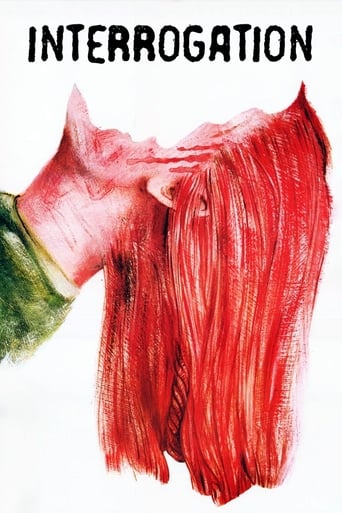
Interrogation (1989)
Przesłuchanie
In Stalinist Poland, cabaret singer Tonia decides to spend the evening drinking with a group of friends. The next morning, she awakes to find that, for reasons unknown to her, she has been jailed as a political prisoner. As prison officials interrogate, torture and humiliate her, she fights for survival and to maintain her innocence by refusing to sign a false confession. As her years of imprisonment pass, her relationship with her captors grows more complicated.
- Date of release
- 1989-12-13
- TMDB
- 7.1 / 10 (78)
- Runtime
- 1h 58m
- Genres
- Drama, Thriller, Crime
- Director
- Ryszard Bugajski
Casting
- Krystyna Janda — Antonina Dziwisz
- Adam Ferency — Lieutenant Morawski
- Janusz Gajos — Major Zawada "Kąpielowy"
- Agnieszka Holland — Communist Witkowska
- Bożena Dykiel — Honorata
- Olgierd Łukaszewicz — Konstanty Dziwisz
- Anna Romantowska — Mira Szajnert
- Tomasz Dedek — UB Officer
- Jan Jurewicz — Guard
- Jarosław Kopaczewski — UB Officer
- Zofia Balucka — Cell-mate
- Arkadiusz Bazak — Officer at Name-Day Party
Interesting facts
- Awards: 0 · Nominations: 3
Interrogation is a Polish film about false imprisonment under the Stalinist pro-Soviet Polish regime in the early 1950s. Completed in 1982, the film was directed by Ryszard Bugajski and first released in 1989. The plot follows an ordinary, apolitical woman named Tonia, played by Krystyna Janda. She refuses to cooperate with the abusive system and its officials, who are trying to force her to incriminate a former incidental lover, now an accused political prisoner.
Production and release
The film was directed by Ryszard Bugajski and produced by the film studio Zespół Filmowy "X”. Production began in 1981 and was completed in 1982. Its original version contained scenes set in the modern era, wherein the protagonist's daughter attempts to uncover the truth of her mother's past, as covered in the main plot. This "contemporary theme" was considered politically dangerous by the government of Poland at the time.
"We had an obvious example of art today, cinematic art, that cannot, in this situation, be released right away, as it was proposed here. This film is so shocking and the context is so strong, so strongly tied to the present, independent of the intentions of its creators. (...) A mass audience will react to this film unequivocally as, how shall I say, the breaking of human beings by people in Polish uniforms."
At the commission's suggestion, the Minister of Culture forbade the film's release for fear of how the public would react. It was one of many "shelf-films" (Polish: półkowniki) which were archived and only presented to the public following the Revolutions of 1989.
When it was shown at the 1990 Cannes Film Festival, it was both applauded and criticised. Krystyna Janda, the film's lead actress, was awarded as best actress, but some called her performance overly dramatic and criticised the film for not being historically realistic. In reality, the film's director had taken great care in researching the imprisonment of women in Stalinist Poland that he depicted. In an interview, Janda stated that,
The story was really based on the lives of two real women who lived through the Stalinist hell: Tonia Lechmann and Wanda Podgórska, the secretary to Władysław Gomułka. Mrs. Podgórska, who spent six years in prison, including two in an isolation cell, served as my consultant on the film. (...) We had to make sure that we documented the film very well because we had to defend everything we did in front of a review board.
Read on Wikipedia · Text from Wikipedia, CC BY-SA 4.0. Data from Wikidata.
Recommended
- Black Site 2022 · ★ 6.0
- A Crooked Somebody 2018 · ★ 6.3
- The System 2022 · ★ 7.3
- Blood Ties 2013 · ★ 6.1
- Pigs 2: The Last Blood 1994 · ★ 6.7
- The Pigs 1992 · ★ 7.0
- The Quiller Memorandum 1966 · ★ 5.9
- The Public Eye 1992 · ★ 6.2
- King Ivory 2025 · ★ 7.0
- Pigs 3 2020 · ★ 6.6
- The Parts You Lose 2019 · ★ 6.7
- Inside Man 2023 · ★ 6.2