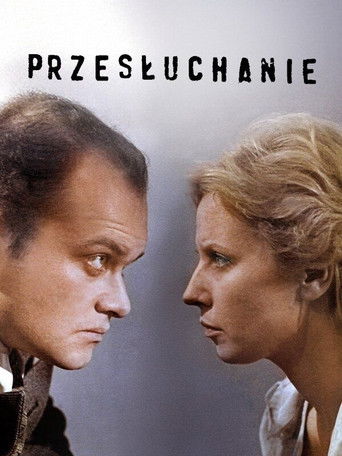
Допрос (1989)
Przesłuchanie
С похмелья Тония просыпается в тюрьме, не имея понятия, как она там оказалась. Ее начинают допрашивать о преступлении, о котором она ничего не знает.
- Дата выхода
- 1989-12-13
- TMDB
- 7.1 / 10 (78)
- Длительность
- 1 ч 58 мин
- Жанры
- драма, триллер, криминал
- Режиссёр
- Ryszard Bugajski
В ролях
- Krystyna Janda — Antonina Dziwisz
- Adam Ferency — Lieutenant Morawski
- Януш Гайос — Major Zawada "Kąpielowy"
- Agnieszka Holland — Communist Witkowska
- Bożena Dykiel — Honorata
- Olgierd Łukaszewicz — Konstanty Dziwisz
- Anna Romantowska — Mira Szajnert
- Tomasz Dedek — UB Officer
- Jan Jurewicz — Guard
- Ярослав Копачевский — UB Officer
- Zofia Balucka — Cell-mate
- Arkadiusz Bazak — Officer at Name-Day Party
Интересные факты
- Наград: 0 · Номинаций: 3
Interrogation is a Polish film about false imprisonment under the Stalinist pro-Soviet Polish regime in the early 1950s. Completed in 1982, the film was directed by Ryszard Bugajski and first released in 1989. The plot follows an ordinary, apolitical woman named Tonia, played by Krystyna Janda. She refuses to cooperate with the abusive system and its officials, who are trying to force her to incriminate a former incidental lover, now an accused political prisoner.
Production and release
The film was directed by Ryszard Bugajski and produced by the film studio Zespół Filmowy "X”. Production began in 1981 and was completed in 1982. Its original version contained scenes set in the modern era, wherein the protagonist's daughter attempts to uncover the truth of her mother's past, as covered in the main plot. This "contemporary theme" was considered politically dangerous by the government of Poland at the time.
"We had an obvious example of art today, cinematic art, that cannot, in this situation, be released right away, as it was proposed here. This film is so shocking and the context is so strong, so strongly tied to the present, independent of the intentions of its creators. (...) A mass audience will react to this film unequivocally as, how shall I say, the breaking of human beings by people in Polish uniforms."
At the commission's suggestion, the Minister of Culture forbade the film's release for fear of how the public would react. It was one of many "shelf-films" (Polish: półkowniki) which were archived and only presented to the public following the Revolutions of 1989.
When it was shown at the 1990 Cannes Film Festival, it was both applauded and criticised. Krystyna Janda, the film's lead actress, was awarded as best actress, but some called her performance overly dramatic and criticised the film for not being historically realistic. In reality, the film's director had taken great care in researching the imprisonment of women in Stalinist Poland that he depicted. In an interview, Janda stated that,
The story was really based on the lives of two real women who lived through the Stalinist hell: Tonia Lechmann and Wanda Podgórska, the secretary to Władysław Gomułka. Mrs. Podgórska, who spent six years in prison, including two in an isolation cell, served as my consultant on the film. (...) We had to make sure that we documented the film very well because we had to defend everything we did in front of a review board.
Читать в Википедии · Текст из Википедии, CC BY-SA 4.0. Данные Викиданных.
Рекомендуем
- Координаты «Цитадель» 2022 · ★ 6.0
- Бесчестный 2018 · ★ 6.3
- Система 2022 · ★ 7.3
- Кровные узы 2013 · ★ 6.1
- Псы 2 1994 · ★ 6.7
- Псы 1992 · ★ 7.0
- Меморандум Квиллера 1966 · ★ 5.9
- Фотограф 1992 · ★ 6.2
- Король слоновой кости 2025 · ★ 7.0
- Псы 3: За Честь 2020 · ★ 6.6
- Тот, кто меня слышит 2019 · ★ 6.7
- Под прикрытием 2023 · ★ 6.2