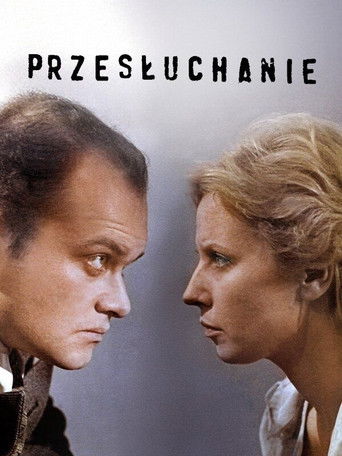
审问 (1989)
Przesłuchanie
在波兰铁幕时期,托妮娅是歌舞团一位歌舞演员,同在剧团的丈夫康斯坦丁在外寻花问柳让她伤心不已,为此,她和崇拜者去酒吧借酒消愁,忧伤让她喝得大醉,等到她醒来发现自己被关进了拘留所,她以为关几天就没事了,不料,当局却指控她犯了里通外国的罪名,并且和反对派勾结在一起,为了让她服罪,监狱主管少校想出了种种卑鄙的方式逼她就范,在一次次疲劳战和心理战里托妮娅到了崩溃的边缘,可是,托妮娅自始至终表明自己的无罪和无辜,在这个过程里,监狱里的一名少尉从开始的刻板的专政者到逐渐审视他所看见的一切,他开始同情的托尼娅的遭遇并经常在暗中帮助她,最后甚至和她发生了关系......
- 上映日期
- 1989-12-13
- TMDB
- 7.1 / 10 (78)
- 片长(分钟)
- 1小时58分钟
- 类型
- 剧情, 惊悚, 犯罪
- 导演
- Ryszard Bugajski
演员阵容
- Krystyna Janda — Antonina Dziwisz
- Adam Ferency — Lieutenant Morawski
- 扬努斯·加约斯 — Major Zawada "Kąpielowy"
- 阿格涅丝卡·霍兰 — Communist Witkowska
- Bożena Dykiel — Honorata
- Olgierd Łukaszewicz — Konstanty Dziwisz
- Anna Romantowska — Mira Szajnert
- Tomasz Dedek — UB Officer
- Jan Jurewicz — Guard
- Jarosław Kopaczewski — UB Officer
- Zofia Balucka — Cell-mate
- Arkadiusz Bazak — Officer at Name-Day Party
趣闻
- 获奖:0 · 提名:3
Interrogation is a Polish film about false imprisonment under the Stalinist pro-Soviet Polish regime in the early 1950s. Completed in 1982, the film was directed by Ryszard Bugajski and first released in 1989. The plot follows an ordinary, apolitical woman named Tonia, played by Krystyna Janda. She refuses to cooperate with the abusive system and its officials, who are trying to force her to incriminate a former incidental lover, now an accused political prisoner.
Production and release
The film was directed by Ryszard Bugajski and produced by the film studio Zespół Filmowy "X”. Production began in 1981 and was completed in 1982. Its original version contained scenes set in the modern era, wherein the protagonist's daughter attempts to uncover the truth of her mother's past, as covered in the main plot. This "contemporary theme" was considered politically dangerous by the government of Poland at the time.
"We had an obvious example of art today, cinematic art, that cannot, in this situation, be released right away, as it was proposed here. This film is so shocking and the context is so strong, so strongly tied to the present, independent of the intentions of its creators. (...) A mass audience will react to this film unequivocally as, how shall I say, the breaking of human beings by people in Polish uniforms."
At the commission's suggestion, the Minister of Culture forbade the film's release for fear of how the public would react. It was one of many "shelf-films" (Polish: półkowniki) which were archived and only presented to the public following the Revolutions of 1989.
When it was shown at the 1990 Cannes Film Festival, it was both applauded and criticised. Krystyna Janda, the film's lead actress, was awarded as best actress, but some called her performance overly dramatic and criticised the film for not being historically realistic. In reality, the film's director had taken great care in researching the imprisonment of women in Stalinist Poland that he depicted. In an interview, Janda stated that,
The story was really based on the lives of two real women who lived through the Stalinist hell: Tonia Lechmann and Wanda Podgórska, the secretary to Władysław Gomułka. Mrs. Podgórska, who spent six years in prison, including two in an isolation cell, served as my consultant on the film. (...) We had to make sure that we documented the film very well because we had to defend everything we did in front of a review board.
在维基百科阅读更多 · 文本来自维基百科,CC BY-SA 4.0。数据来自 Wikidata。