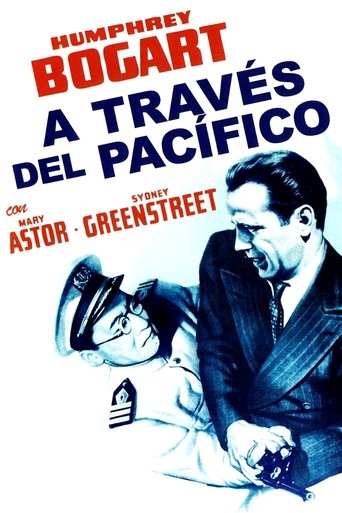
A través del Pacífico (1942)
Across the Pacific
¡Un éxito de Warner Bros.!
Bogart interpreta a un oficial de artillería del ejército nortamericano que, en 1941, tras un juicio militar, cae en desgracia y decide abandonar el país. Consigue un trabajo en América Central, pero cuando está a punto de irse descubre que los japoneses proyectan atacar el Canal de Panamá y las bases americanas en Pearl Harbor.
- Fecha de estreno
- 1942-09-04
- TMDB
- 6.6 / 10 (90)
- Duración
- 1 h 37 min
- Géneros
- Aventura, Suspense, Drama
- Director
- John Huston
Reparto
- Humphrey Bogart — Rick Leland
- Mary Astor — Alberta Marlow
- Sydney Greenstreet — Dr. Lorenz
- Charles Halton — A.V. Smith
- Victor Sen Yung — Joe Totsuiko
- Roland Got — Sugi
- Lee Tung Foo — Sam Wing On
- Frank Wilcox — Capt. Morrison
- Paul Stanton — Col. Hart
- Lester Matthews — Canadian Major
- John Hamilton — Court-Martial President
- Tom Stevenson — Unidentified Man
Curiosidades
Across the Pacific is a 1942 American spy film set on the eve of the entry of the United States into World War II. It was directed first by John Huston, then by Vincent Sherman after Huston joined the United States Army Signal Corps. It stars Humphrey Bogart, Mary Astor, and Sydney Greenstreet. Despite the title, the action never progresses across the Pacific, concluding in Panama. The original script portrayed an attempt to avert a Japanese plan to invade Pearl Harbor. When the real-life attack on Pearl Harbor occurred, production was shut down for three months, resuming on March 2, 1942, with a revised script changing the target to Panama.
Production
On Dec. 20, 1941, The New York Times reported the sale of Robert Carson's story "Aloha Means Goodbye", which was originally published in The Saturday Evening Post, for $12,500.
After the hiatus caused by the attack on Pearl Harbor, production resumed on March 2, 1942, and filming continued through May 2, 1942 (including retakes). The film opened in New York City on September 4, 1942.
Colonel J. G. Taylor was technical advisor for the court-martial scene that opens the film.
Turner Classic Movies' Bret Wood reports that John Huston created the effect of being on the ocean by having the set of the ship's deck built on a platform supported by hydraulic lifts to keep everything moving. In some of the interior shots, “The camera subtly, almost imperceptibly, edges toward and away from the actors, providing a vaguely disorienting effect that well serves the film's ever-shifting moral ground.”
Adolph Deutsch turned the Engineers Hymn (as played to the tune of “The Son of a Gambolier”) into an evocative theme for the character of Richard Leland (Humphrey Bogart). A few poignant measures of West Point's “Alma Mater” are also heard after the court-martial, when Leland looks at his class ring and puts it back on his finger.
Leer en Wikipedia · Texto de Wikipedia, CC BY-SA 4.0. Datos de Wikidata.
Recomendadas
- El pirata negro 1926 · ★ 6.7
- El lobo de mar 1941 · ★ 7.2
- Espíritu libre 2023 · ★ 7.0
- El último viaje 1960 · ★ 6.2
- Con la muerte en los talones 1959 · ★ 8.0
- La aventura del Poseidón 1972 · ★ 7.2
- La espía que me amó 1977 · ★ 6.8
- Natty Gann 1985 · ★ 6.8
- La mujer pirata 1951 · ★ 6.4
- La verdad sobre Emmanuel 2013 · ★ 6.0
- El Experimento Filadelfia 1984 · ★ 6.1
- La hora decisiva 2016 · ★ 6.6